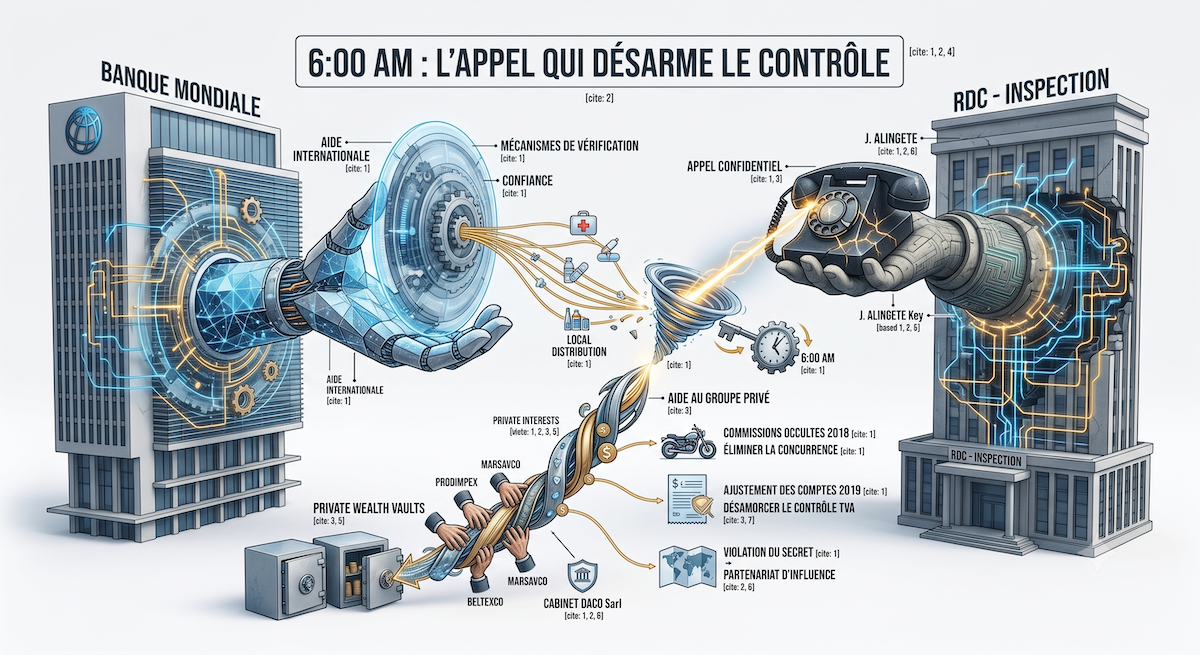
Following the case of the motorcycles in the 2018 Ebola response, our editorial team has gained access to a second document which, when put together with the first, outlines a repeated modus operandi: neutralizing, from within the very apparatus of state control, the verification mechanisms that international donors impose in return for their trust.
What the events of 2018 had already revealed
On July 20, 2026, the African Development Bank Group announced a $13 million grant to support the response to the 17th Ebola virus disease outbreak in the Democratic Republic of Congo, South Sudan, and Uganda, including $11 million for the DRC alone, deployed primarily through the World Health Organization.
The announcement, hailed as a gesture of international solidarity, nevertheless revived memories of a previous incident: in 2018, as part of a $584,810 contract financed by the World Bank (credit PDSS-IDA55720-ZR) and intended to equip area monitors with motorcycles to combat a previous Ebola outbreak, internal correspondence within Prodimpex SARL, a subsidiary of the group headed by the Rawji family, documented the negotiation of a hidden commission of $500 per motorcycle ($71,500 in total), explicitly described by its authors as intended to "eliminate the competition." In this exchange, Adnan Rawji himself urged his teams to increase the prices charged to the program, citing the humanitarian emergency as a negotiating argument rather than a deterrent.
This case is part of a broader legal dispute that has pitted the Rawji family and Jules Alingete Key, former Inspector General of Finance of the DRC, against the Congolese justice system for several years. This dispute was marked, on June 20, 2026, by a request for a travel ban targeting several members of the Rawji family, as well as Mr. Alingete and his wife, before a press release, published less than two weeks later, downplayed the significance of this measure.
A separate document, which our editorial team was able to consult and authenticate independently, now allows us to document a second episode, several years prior to this legal outcome, in which the same Mr. Alingete allegedly intervened personally to circumvent a control mechanism demanded, this time not by the World Bank for a specific project, but by the Congolese government itself at the explicit request of the same institution.
November 2019: A call at six o'clock in the morning
The document in question is an email dated November 5, 2019, sent by Franck Lumbala, head of the finance and tax department of Marsavco (another subsidiary of the Rawji group), to Dominic Freundorfer, head of Prodimpex, with Mr. Alingete himself copied. The message concerns a "joint audit" of value-added tax, a joint mission of the Directorate General of Taxes and the Directorate General of Customs and Excise, whose mandate, according to the email itself, had been entrusted by the Minister of Finance "at the request of the Government and the World Bank."
According to this document, whose technical authenticity has been verified (valid DKIM cryptographic signature, linked to the professional email domain of
Marsavco, one of the most robust guarantees of authenticity our editorial team has encountered in this entire case), Mr. Alingete allegedly contacted Mr. Lumbala by telephone at 6:00 a.m. the day before the mission, to warn him of its imminent arrival and to ask him to adjust his books and inventory before the inspectors' arrival.
One point deserves emphasis at this stage: this email was not sent solely to the head of Prodimpex. It was copied to nine additional addresses, spread across no fewer than five separate companies within the Rawji Group, as well as to Mr. Alingete himself. This distribution demonstrates that the alert was not treated as a matter confined to Marsavco, but rather as information of interest to the entire conglomerate:
- Kumar Anand, Chief Financial Officer of Marsavco;
- Divyesh Mangroliya and Patrick, executives at Marsavco;
- Shoya, from the accounting department of Beltexco;
- Mbuta, in charge of tax matters at Parkland;
- Banza, from Proton;
- Jules Alingete himself;
- Prodimpex's finance department, via the generic email address cfo@prodimpex.com;
- Beltexco's finance department, via the generic email address cfo@beltexco.com.
Of these nine email addresses, seven correspond to specifically identified individuals; the last two (cfo@prodimpex.com and cfo@beltexco.com) are generic service email addresses, without any individual name attached to them in the message header.
This distribution to five separate companies within the group for a single audit ostensibly targeting Marsavco suggests that the information transmitted by Mr. Alingete, and the accompanying instruction to adjust the books before the inspectors' arrival, was perceived internally as relevant far beyond the scope of the company directly involved in this joint audit. The presence of Mr. Alingete himself among the recipients copied on this email warrants particular attention in this regard. A public official who transmits confidential information through an informal channel (in this case, an early morning phone call, not recorded as such) normally has no reason to be copied on the resulting written report within the receiving company, unless they themselves wish to have proof that the information was indeed relayed and acted upon. Including them on the report can thus be interpreted as a form of implicit acknowledgment of receipt between the group's companies and themselves, confirming that the alert given that morning had been transmitted, understood, and taken seriously by all the subsidiaries concerned, and simultaneously demonstrating the importance they themselves attached to this information.
The audit in question was therefore not aimed at an isolated company suspected of irregularities: it stemmed from an institutional requirement formulated by an international donor concerned with verifying the reliability of Congolese tax revenues, precisely the type of safeguard that the DRC's financial partners, the World Bank foremost among them, emphasize to justify continuing their budgetary and sectoral support to the country. That the man placed at the head of the Congolese financial oversight body could, according to this document, neutralize its useful effect for the benefit of a company with which his own family firm also maintained a direct business relationship is not a minor detail: it is, potentially, the keystone of the entire system.
Two cases, one modus operandi
Placed side by side, the two episodes (the 2018 Ebola motorcycle commission and the 2019 VAT audit alert) reveal a coherent pattern that, according to information already documented by other media outlets, is found in several other cases involving the same protagonists: that of an administration supposedly protecting the public interest and the trust of donors, but whose officials allegedly, on several occasions and over several years, directed their actions to benefit the same group of private interests.
The documented common thread between these two cases has a name: DACO Sarl, the accounting firm of which Mr. Alingete is presented, according to several previously published journalistic investigations, as the majority shareholder, and his wife, Nanu Mukawa, as the manager. This firm, according to these same sources, allegedly advised most of the companies in the Rawji group (Beltexco, Prodimpex, Rawbank, Marsavco, Proton, Parkland, RAFI) on strategies to reduce their tax burden, starting in 2016, even before Mr. Alingete took over as head of the General Inspectorate of Finance. It is this same relationship which, according to our analysis, could explain why a joint audit required by the World Bank itself could have been rendered meaningless the day before it was to take place.
Criminal Classification of the Acts
Subject to the presumption of innocence to which all individuals mentioned in this investigation are entitled, the evidence gathered is likely to be subject to several distinct criminal classifications, the seriousness of which is directly linked to the fact that the mechanisms in question were specifically designed to protect funds or arrangements financed or required by international donors.
Violation of professional secrecy and tax investigation
The advance disclosure, by the head of the state's financial oversight body, of the conduct and timing of a tax audit to the company intended to be audited, is likely to constitute a breach of the confidentiality to which all public officials are bound in the performance of their oversight duties.
Influence peddling and passive corruption
If the existence of a financial link between Mr. Alingete, his firm DACO, and the companies in the Rawji group were to be established through adversarial proceedings, the documented personal involvement in the 2019 VAT case, as well as in the 2018 PDSS case, could constitute influence peddling, or even corruption, insofar as the benefit derived by the official—the continuation of a lucrative business relationship for his own firm—would be directly linked to actions taken in the exercise of his oversight duties. Maneuvers intended to thwart an audit required by an international donor
This is where the specificity of this second case lies compared to the first: while the Ebola motorcycle affair documented fraud committed during the execution of a contract financed by a donor, the VAT audit affair documents a direct attack on the oversight mechanism itself, the one that the World Bank had explicitly requested of the Congolese government. Obstructing this audit amounts to depriving the international donor of the very guarantee for which it had demanded it, and could, as such, be considered a fraudulent maneuver committed to the detriment not only of the Congolese public treasury, but also of the relationship of trust between the DRC and its international financial partners, a relationship upon which, concretely, the continuation of aid programs such as the one announced in July 2026 for the response to the 17th Ebola epidemic depends.
Forgery and Use of Forged Accounting Documents
The instruction, reported in the email of November 5, 2019, to adjust the books and inventory before the arrival of an audit team mandated at the request of an international lender, could constitute, if carried out, forgery of accounting documents intended to mislead the audit team regarding the true tax situation of the company being audited.
Complicity of the DACO Sarl Firm
If the involvement of this firm in structuring the Rawji group's tax schemes is confirmed, its position as a regular intermediary between the group's companies and the tax authorities headed by its principal shareholder could constitute complicity, if not joint perpetration, in all of the above-mentioned offenses.
The same question, asked twice.
Two cases, two different donors: the World Bank for the direct financing of an emergency medical contract in 2018, the World Bank again for the requirement of a tax audit in 2019, and, according to the documents gathered in this case, the same man at the heart of both outcomes. As an additional $11 million is about to be committed to the DRC in the name of combating a new Ebola epidemic, the question posed by our editorial team in a previous investigation remains unanswered, and these new elements give it added weight: what guarantees exist today to ensure that the control mechanisms demanded by international donors will not, as in 2018 and 2019, be undermined from within before they can even have an effect?
Our editorial team sought a response from Mr. Alingete, Mr. Adnan Rawji, the Prodimpex-Marsavco group, and the DACO Sarl firm. No response had been received at the time of publication. This article will be updated if we receive any such responses.
Methodology. The information relating to the November 2019 VAT joint audit is based on the analysis of an email and its technical headers, the authenticity of which was cryptographically verified (DKIM signature) prior to publication. The information relating to the 2018 Ebola response motorcycle case and the broader context of the Rawji-Alingete affair reiterates, with attribution, the information already published in our previous investigation and in the sources cited therein (African Development Bank Group, DeskEco, Finance-cd.com/Chronik'Eco, La Prospérité.cd). The amounts and identities mentioned correspond to the content of these documents; they have not, at this stage, been independently verified by the courts.