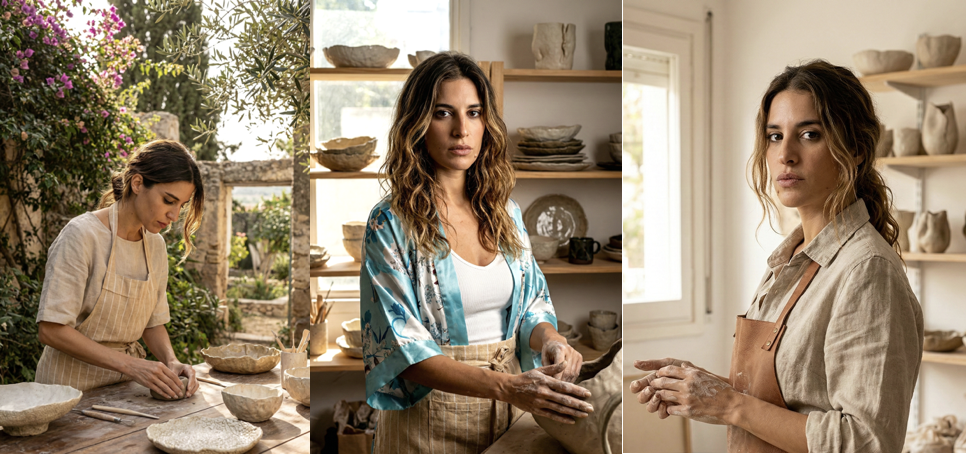
When Art and Design Meet...
Within the vibrant landscape of contemporary Tunisian art, a generation of artists in their forties is emerging with remarkable vitality, embodying the creative genius of a nation where a millennia-old heritage merges seamlessly with modern innovation. At the heart of this movement stands Leila Samoud, better known by her evocative pseudonym, Leeloo—a tribute to the iconic character from Luc Besson’s The Fifth Element, a figure who combines unwavering strength with poetic fragility.
At 41, this Tunis-based artist and founder of Cleï Ceramics transforms clay into works of raw elegance—unique pieces that capture the essence of nature while bearing the unmistakable imprint of the hands that created them.
With Leeloo, art and design come together to celebrate authenticity. Her work invites us to touch the sublime, to feel the vital pulse of a creation that transcends raw matter itself.
Tunisian to Her Fingertips...
Born on August 20, 1984, in Tunis, Leeloo grew up in the enchanting atmosphere of Hammamet, where her father, the charismatic manager of the five-star El Manar Hotel, instilled in her a natural sense of hospitality and refinement.
Yet it was in the gardens of Les Colombes Hotel, the first establishment managed by her father, that she experienced a defining childhood memory. Fascinated, she watched a potter shaping clay on a wheel before her eyes—a mesmerizing scene that would later prove prophetic.
Her mother, a biology technician blessed with boundless creativity—spanning theatre, floral decoration, and drawing—nurtured her imagination, despite an educational environment that often relegated art to the status of a mere hobby.
Raised between the beaches of Hammamet and the classrooms of Nabeul, the historic cradle of Tunisian ceramics, Leeloo unconsciously absorbed the floral and natural motifs that permeate local craftsmanship.
Her five intensive years studying graphic design at the Higher Institute of Design Sciences and Technologies sharpened her artistic vision. It was during her university years that friends, struck by her unique personality—a blend of fierce determination and penetrating lucidity—nicknamed her "Leeloo," after Besson’s heroine who embodies the very essence of love.
A subsequent specialization in 3D animation under the guidance of Belgian pioneer Jean-Yves Arboit, a collaborator of George Lucas's ILM studios, introduced her to virtual worlds. Yet it was during an exhilarating internship at a communications agency in Toulouse, serving luxury clients and an iconic interview magazine, that she first tasted true creative freedom.
Although offered a position there, family circumstances compelled her to return to Tunisia. Back home, agency work confined her behind computer screens, stifling her deep-seated need to create with her own hands.
Clay: A Biblical Material...
The year 2019 marked a turning point—an irresistible call toward clay, that biblical material associated with the creation of Adam.
She first learned the fundamentals in Nabeul before refining her craft in Tunis. But driven by relentless standards and an insatiable desire to learn, Leeloo set off for San Francisco. For six months, she immersed herself in workshops led by renowned ceramic artists, exploring and experimenting without pause.
There, master ceramicist John Conrad recognized within her—before she herself fully realized it—the essence of wabi-sabi, the Japanese philosophy that celebrates imperfection, simplicity, and a profound connection with nature.
"Her minimalist creations carry powerful symbolism, deeply rooted in the earth," one often hears within artistic circles.
Leeloo's pieces do not seek industrial perfection or mechanical symmetry. They reject straight lines in favor of accident, organic curves, and the traces left by the thumb pressing into clay.
Looking at her creations—irregular-rimmed vessels seemingly sculpted by natural erosion, plates with cracked textures reminiscent of lunar landscapes—one immediately senses a dialogue between humanity and nature.
"I do not seek to tame the earth, but to converse with it. Every piece must preserve the memory of the gesture."
Unlike traditional Tunisian earthenware fired at lower temperatures, Leeloo works primarily with stoneware, a demanding material requiring high-temperature kilns. The result is an unexpected combination of durability and refined elegance.
Today, from her studio nestled within La Ruche, a dynamic co-working space in Bhar Lazreg, Leeloo handcrafts unique pieces, deliberately refusing to use the potter's wheel in order to preserve the raw transmission of emotion.
Each vase, sculpture, and decorative object—drawing inspiration from organic forms without ever becoming figurative—is a declaration of authenticity. The floral motifs of Tunisian craftsmanship subtly reappear, reinvented through clean lines and delicate textures.
Ceramics with Character...
There is something magnetic about Leeloo.
A quiet strength that echoes the very earth she shapes.
Far removed from the stereotypical image of traditional pottery, she embodies a form of ceramics that is both earthy and sophisticated. Watching her work, dressed in raw linen, her dark eyes fixed intently on the clay, one quickly understands that kneading earth is not a pastime for her—it is a passionate struggle with matter itself.
It is no coincidence that her creations have found their way onto the tables of demanding chefs.
Whether through her sculptural pouring vessels or her textured containers, Leeloo's ceramics are far more than simple serving pieces—they are settings that elevate the culinary experience. They create a striking contrast between the delicacy of a refined dish and the carefully orchestrated roughness of its vessel.
This is sensory ceramics, designed to be touched as much as admired.
Holding one of her creations is like touching the artist's soul. The deliberate irregularities—those "perfect imperfections"—allow one to feel the hands that kneaded, caressed, and infused the earth with creative genius.
As a recent social media post aptly observed, her delicate and minimalist objects, shaped according to the inspiration of the moment, embody a rare harmony between fragility and strength—a perfect reflection of her extraordinary personality.
Modesty aside, Leeloo is not merely an artist; she is the ambassador of a Tunisian generation at its creative peak, where local artisanal heritage meets global avant-garde innovation.
Her works, showcased through her platforms under Cleï Ceramics, attract an international audience captivated by their elegance and poetic sensibility.
A Human Luxury in an Industrial World
In an era dominated by industrial design, Leeloo reminds us that true luxury lies in the human touch, in tactility, and in uniqueness.
Through her work, Tunisian creativity shines brightly.
With her free-flowing hair, intense gaze, and signature beauty mark, Leeloo possesses the aura of creators who remain uncompromisingly authentic.
Inside her softly lit studio, amid kaolin dust and raw clay, she has forged a distinctive style where contemporary design reconnects with its most primitive roots.
With Leeloo, ceramics leave the realm of decorative arts and step fully into that of interior architecture:
her creations do not merely decorate a space—they inhabit it.