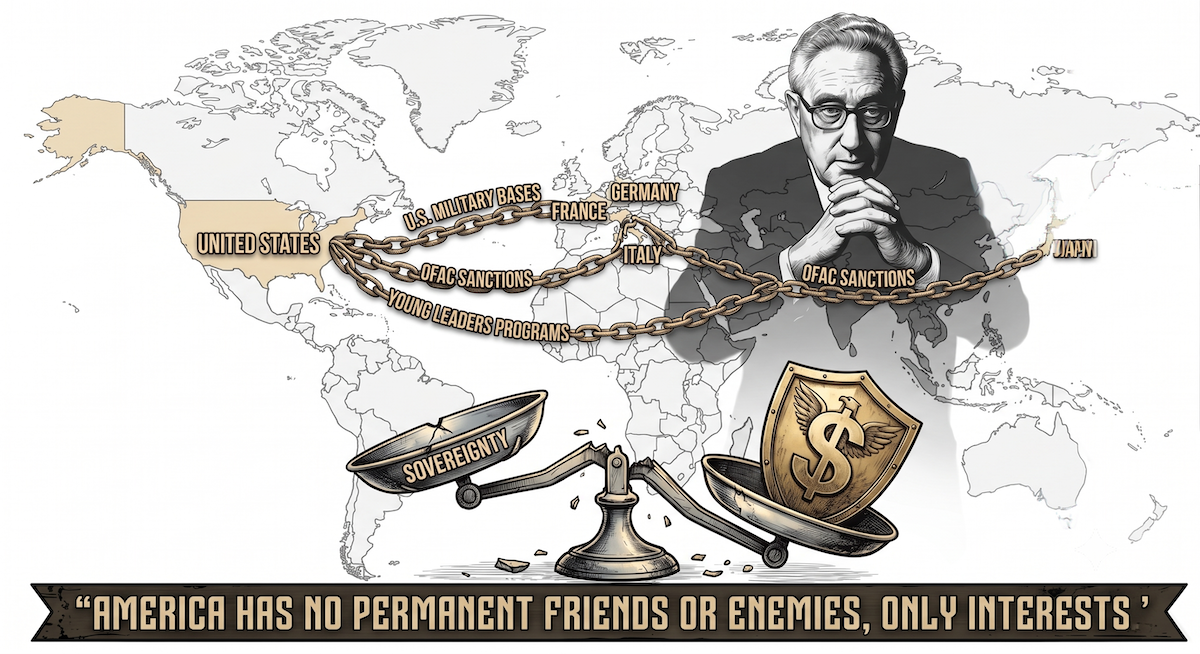
The American Secretary of State had warned even before Richard Nixon's inauguration in November 1968: “It may be dangerous to be the enemy of the United States, but being their friend is fatal.” More than half a century later, this phrase from Henry Kissinger resonates like a funeral oracle over the industrial and strategic ruins of those who believed that the Atlantic alliance protected their vital interests.
Since the 2010s, a deafening silence surrounds the fall of the French nuclear giant Areva, of Alstom dismembered by General Electric, and of a growing number of European jewels "sanctioned to death" by an extraterritorial legal arsenal serving U.S. economic domination. Behind the facade of French nuclear global leadership lie not only a financial heist of several billion euros but also the strategic guardianship of an allied power, France, which today discovers, with bitterness on its lips, the price of its friendship.
A "state affair": the shipwreck of Areva
Acquired at a high price (1.8 billion euros) in 2007, the mining company UraMin turned out to be an industrial mirage: unexploitable deposits, losses exceeding three billion euros for Areva, and a cascade of indictments including that of the group's president, Anne Lauvergeon. In just a few years, the "fully integrated" model that made Areva strong exploded. The subsidiary structure imposed by the state shareholder led to the birth of Orano (fuel cycle) and Framatome (reactors), now controlled by EDF. A fragmented French champion, weakened, unable to compete with Westinghouse or Rosatom.
Even more worrying: all shareholders of UraMin have never been identified. The opaque nature of the arrangement raises heavy geopolitical questions. But it is especially the names of the French decision-makers involved in the dismantling of Areva that intrigue: several high officials who participated in the "Young Leaders" program of the French American Foundation, including three former presidents of the Republic, actively supported the dismemberment of the industrial jewel.
When the ally is dismembered under the cover of law
Areva is not an isolated accident. The Alstom affair (2014-2015) offers a textbook case of the American method: the Department of Justice (DoJ) prosecutes the French group for alleged corruption, imposes a record fine of 772 million dollars, and then, under this judicial pressure, enforces the sale of the energy branch to General Electric for 12.35 billion euros. Frédéric Pierucci, an Alstom executive imprisoned for 25 months in the United States, succinctly summarizes the mechanism: “This is not a trade war between France and the United States; it is a global economic war between the United States, China, and Europe, and there are no friends.”
From 2010 to 2025, BNP Paribas paid nearly nine billion dollars in fines for circumventing U.S. sanctions against Cuba, Sudan, and Iran. Total, Société Générale, Airbus, Thales – all have suffered the extraterritorial law of the OFAC (Office of Foreign Assets Control). This legal weapon allows Washington to sanction any foreign company as long as it uses the dollar or goes through the American banking system. This "law of the strongest" has become the matrix of unprecedented protectionism.
Europe, scarecrow and hostage
Europe pays the price of its dependence. At the beginning of 2025, the Montaigne Institute published a warning note: the European Union still has no clear policy regarding extraterritoriality, while the United States makes it a key tool to defend its national interests. The result: European companies must choose between complying with U.S. sanctions and violating European law, or exposing themselves to colossal fines.
On the Old Continent, the awareness of this trap is spreading.
A Pew Research Center survey published in July 2025 shows that in ten high-income countries (Canada, France, Germany, Italy…), the popularity rating of the United States drops from 51% to 35% in one year. At the same time, the image of China is improving, driven by a growing distrust of an American partner deemed increasingly unreliable.
Africa, a Mirror of French Decline
From west to east, the entire French influence strategy is faltering. The year 2025 has been one of accelerated retreat: the end of uranium exports from Niger, the rupture of defense agreements with Chad, Senegal, and Côte d'Ivoire. A pan-African analyst bitterly summarizes: “France no longer understands geopolitics and is mistaken about the current situation.” This isolation is all the more cruel as the expanded BRICS (Egypt, Ethiopia, Iran, Indonesia, Saudi Arabia…) now attract the majority of countries in the global South, weary of an asymmetric relationship where Western “aid” is negotiated in economic and military influence. Paris is trying to promote a coalition multilateralism with Brazil or India, but this strategy would struggle if it is not accompanied by a radical overhaul of French strategic autonomy.
The Inertia of Elites: A Silent Betrayal
The heart of the problem is not technical but political. The “Young Leaders” exchange programs have influenced several generations of French decision-makers, from Nicolas Sarkozy to Emmanuel Macron. Even if the French-American Foundation denies any direct link with the CIA, the cultural and strategic influence of these transatlantic networks is undeniable. This porosity has led to a form of fatal inertia: accepting the filialization of nuclear power, renouncing vertical integration, tolerating the sale of Alstom, never contesting American extraterritoriality. When in January 2026, President Macron declares: “The United States is gradually turning away from certain allies,” the sentence falls, not without irony: it is France that has been turned away from its own sovereignty, long before Washington turned its back.
An Architecture to Rebuild
Today, the French nuclear sector, instead of being a pillar of strategic autonomy, depends on Orano and Framatome, two entities without an integrated vision. The new French nuclear doctrine, announced in March 2025, insists on “advanced deterrence,” but without complete control of the cycle. The observation is painful: in the global reactor market, Westinghouse, Rosatom, and the Chinese groups CGN/CNNC share contracts that could have gone to Areva. The industrial pact signed in June 2025 to relaunch the EPR2 and small modular reactors (SMR) could prove insufficient if it is not accompanied by a profound political refoundation.
Allies or Occupied Countries?
Such an article could hardly conclude without mentioning the deepest paradox of this architecture of domination: that which consists of considering as “free” the countries that, for nearly eighty years, have been militarily occupied by the United States. For Germany, Italy, and Japan have never truly regained their full sovereignty after 1945. The American occupation, presented at the time as temporary, has morphed into a permanent presence whose legal and political contours reduce the notion of national independence to a mere shadow.
In Germany, more than 36,000 American soldiers are stationed in 2025 in dozens of bases, the most famous of which, Ramstein, serves as a nerve center for American drone operations around the world. The Federal Constitutional Court rejected in July 2025 a complaint filed by two Yemeni nationals whose relatives had been killed by an American strike piloted from German soil, stating that Berlin had no obligation to.
Protecting Foreigners Abroad
This shows how much American extraterritoriality has become the norm. In Italy, the approximately 12,600 American soldiers, along with the 21,000 sailors of the Sixth Fleet, occupy seven main bases, including those in Vicenza, Naples, and Sigonella. Italy may remind that the use of these bases for war operations must be authorized by the Italian government, but the reality is quite different: the United States conducts operations there without always seeking this agreement, and the Italian taxpayer pays between 100 and 200 million euros each year to maintain this foreign presence.
As for Japan, it alone hosts nearly 55,000 American military personnel, spread across more than 80 bases, the majority of which are concentrated on the island of Okinawa. Again, the Status of Forces Agreement (SOFA) signed in 1960 grants near-total immunity to American soldiers: when a crime is committed in service, Japanese justice does not even have jurisdiction. Dozens of violent crimes, assaults, and fatal accidents are thus committed each year without the victims receiving compensation. The Japanese government, which contributes 1.4 billion dollars annually to the costs of these bases, cannot, in law, order the departure of American troops without a joint decision. The writer Murakami Ryū was able to say in 2004 that Japan was "99% an American colony"; history has not proven him wrong.
And yet, none of these three countries defines itself as occupied, none of their leaders say it out loud, and no citizen takes to the streets to demand the closure of these bases. This is where the deepest geopolitical blindness lies: accepting the foreign military presence on its soil as normal, seeing it as a guarantee of security rather than a limitation of its sovereignty.
France's Return to NATO, a Betrayal...
This return was the most symptomatic of the betrayal of the Gaullist spirit. General de Gaulle, who was the first to measure American duplicity, articulated it in 1966 with unambiguous clarity by withdrawing France from NATO's integrated command. For him, this military subordination to Washington was incompatible with national independence. "France considers," he wrote to President Johnson, "that the changes accomplished or in the process of being made no longer justify, as far as it is concerned, the military arrangements made after the conclusion of the alliance. That is why France intends to recover full exercise of its sovereignty on its territory." By demanding the evacuation of all American bases on French soil, the General proved that one could be an ally without being a vassal.
In 2009, by reintegrating these same structures, Nicolas Sarkozy destroyed this exceptional posture. France became a full member of an alliance where the United States retains supreme command. This decision, refusing a sincere debate by resorting to a motion of censure, sparked an "avalanche of criticism," not only from the left but also from historical Gaullists, as it marked a "break with France's traditional policy." This renunciation of Gaullism was not without cost; it was a bargaining chip to obtain, in vain, a command position for France and the advancement of a "European pillar" that never came. By accepting this military protectorate, the French elites completed their submission to Washington, illustrating once again that being a friend of the United States can prove fatal.
Zealous Elites...
The betrayal of the elites, which we mentioned earlier, is not limited to a few decision-makers co-opted by American foundations; it is mainly manifested by this silent adherence to the idea that freedom can coexist with the condition of a protectorate. It is therefore hardly surprising that the rest of the world, and particularly the Global South, looks at these willing vassals with a mixture of astonishment and contempt. For in the end, how can one still believe in the Western promise of sovereignty and self-determination when the United States treats its allies as forward bases, and they thank them in return?
In this great game of dupes, the fatal friendship that Kissinger described is not only paid for by the loss of the nuclear industry or economic freedom; it is paid for by the insidious and definitive loss of what founds a State: the ability to say no, to define oneself, to live without a guardian. The countries that still escape this domination – and there are many – observe, learn, and draw consequences.
France, Germany, Italy, Japan are today nominal democracies administered by elites who no longer have the reflex of sovereignty. This may be the greatest American victory: having transformed occupation into habit, and habit into forgetfulness. The fall of Areva is just an episode in a much larger economic war. In May 2025, Alstom had to conclude a prior agreement with the DoJ, risking a new fine. History repeats itself, tirelessly, as long as Europe refuses to equip itself with legal and financial counter-response instruments that are up to the task.
The Trump Advantage…
An unexpected advantage of Donald Trump in the narrative of this underground domination is this: he no longer plays the masked man. His predecessors, elegant and multilingual, spoke of "defending the liberal order" while piloting from the White House a drone war more deadly than that of George W. Bush, discreetly threatening their allies with extraterritorial coercion and maintaining military bases in nominally "sovereign" countries. Trump, on the other hand, embraces the brutality of the contract. He tells Germany and Japan: "You are not paying enough for your protection," he explicitly threatens to let Russia do what it wants with NATO members who are behind on payments, he announces in Brussels that tariffs are not an anomaly but a permanent instrument of economic blackmail.
Yet, fundamentally, he is only continuing and sometimes amplifying the policy of his predecessors. His immediate predecessor, Joe Biden, had retained the tariffs on China inherited from Trump, continued the withdrawal from Afghanistan planned by his Republican predecessor, and continued to supply arms to Ukraine – a continuity that analysts qualify as "iceberg": what emerges from the water changes shape, but the underwater mass hardly moves. What has truly changed is the tone. Cynicism is no longer wrapped in democratic veils. And this frankness, however perverse it may be, offers his European allies a decisive advantage: no more excuses.
No one can claim to ignore that the military occupation of Germany, Japan, and Italy since 1945 is not a guarantee of disinterested security, but a strategic tutelage paid for by the loss of sovereignty. Trump's first merit, ultimately, is having torn the veil of hypocrisy that led one to believe that one could be "friends of the United States" without paying the price. For now, he states aloud what his predecessors accomplished in the shadows: being an ally of the United States means being a vassal, and if the vassal finds the contract inequitable, let him go tell Moscow or Beijing.