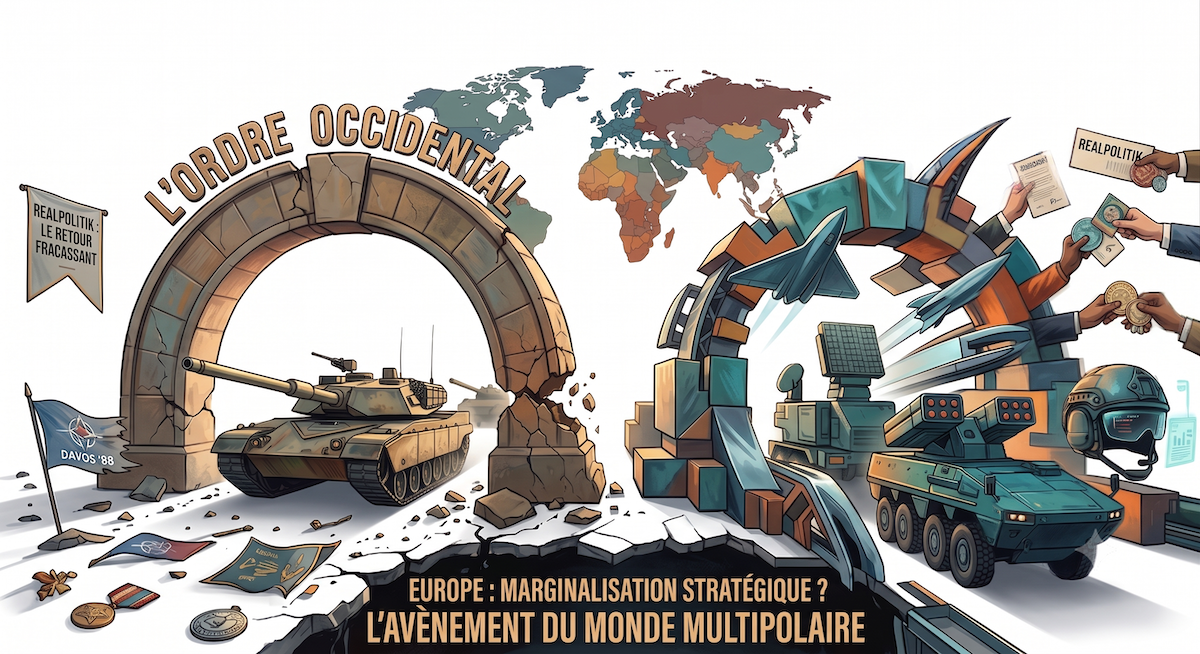
Imagine for a moment the “great circus” of global defence in 1998. The arms industry was like a three-lane motorway, all one-way: the United States, Europe, and a “rest of the world” asked to queue up, catalogue in hand and wallet open. The die was cast. The dogma of the “End of History” reigned supreme, and the Davos Forum could strut about, confident in its ability to dictate its “values” and “standards” to the world.
Fast forward to 2026. Open the doors to the Villepinte Exhibition Centre. The decorum is the same, but the atmosphere is radically different. The technological superiority of a unipolar bloc is no longer being celebrated here. What we see, amidst a tumult of stands and negotiations, is the noisy and irreversible advent of the multipolar world. Eurosatory 2026 will not be the exhibition of the “camp of good” against the “autocracies”. It will be the bazaar of realpolitik, where yesterday’s preachers are reduced to the role of supplicants.
This is the chronicle of a shift long foretold.
The “Rules-Based Order”? A skeleton in the Villepinte closet
We must call a spade a spade. The 2026 edition of the forum is taking place against a backdrop of geopolitical ruin, amidst the still-smouldering ruins of the Davos myth. The ritual of the “rules-based order” - that mantra repeated ad nauseam in the corridors of the World Economic Forum - has fizzled out. "The eulogy for globalist hypocrisy" is being delivered everywhere, including by those at the helm. At the last Davos Forum, the conclusion was a bitter one: universalist and globalist narratives were conspicuous by their “notable absence”, replaced by the realism of power dynamics and “pragmatic power politics”.
The Eurosatory 2026 exhibition is the concrete manifestation, in alloys, drones and missiles, of this hangover. Companies no longer come here seeking the blessing of a “world policeman” on the verge of strategic exhaustion. They come to negotiate, on equal terms, in a world where, according to one expert, European elites are threatened not by military defeat, but by outright “strategic marginalisation” in the great multipolar game unfolding between Washington, Beijing, Moscow and New Delhi.
The collective West is living out its worst nightmare: becoming a mere strategic peninsula of the Eurasian continent.
The end of moralising
Let’s be brutally honest: for decades, Western arms fairs were like lessons in geopolitical catechism. A European minister would sell you a batch of frigates, but the contract came with a 250-page moral instruction manual on human rights. An American firm would offer you a radar system, whilst reminding you of the ‘sanctions’ that would befall you if you dared to trade with Moscow or Beijing. You bought equipment, and you left with a roadmap for good governance.
Those days are gone.
Now, moral blackmail no longer works. Why? Because arms dealers are no longer just in Paris, Washington or Berlin. They are in Ankara, New Delhi, Seoul, Abu Dhabi, Brasília and Cape Town. The countries of the “Global South”, which we thought were doomed to be eternal customers, have become suppliers, partners and competitors. And they are setting their own rules. The first of these: never choose between the soup and the sermon.
The figures are staggering. By 2030, European defence budgets could reach €970 billion. Yet emerging nations are no longer mere supplicants: they are demanding technology transfers, joint production and industrial compensation. They buy at the best price, and above all from the best partner. And if Europe continues to play the schoolmistress, they will look elsewhere.
The lesson is clear: in the new world, weapons have no moral scent; they have only a price and an effectiveness. It is the resounding return of Realpolitik.
Welcome to the bazaar of the new powers
Take a stroll through the aisles of Eurosatory 2026. Observe the mosaic of stands. The contrast with the monolithic nature of yesteryear is striking.
- The Turkish stand. Ankara is the perfect embodiment of this shift. Under Erdoğan’s leadership, the country has developed a sovereign defence industry, which accounts for over $7 billion in annual exports, compared with just $2.6 billion for India. The Bayraktar TB2 drones, true stars of the Ukrainian and Syrian battlefields, have become global bestsellers. But Turkey is not content merely to sell: it is building “ecosystems” of co-production with Gulf countries, from Pakistan to Qatar via Azerbaijan, weaving a web of influence that completely escapes Brussels’ radar. Turkey practises strategic “multi-alignment” with unabashed cynicism: a NATO member on Monday, a partner of Moscow on Tuesday, a supplier to Ukraine on Wednesday.
- The Indian pavilion. New Delhi presents itself as “Vishwa Bandhu” (friend of the world). India buys Russian S-400s, French Rafales, American drones, and is developing its own fifth-generation fighter. It refuses to choose sides, whilst signing a defence agreement with Armenia, a country in a simmering conflict with Azerbaijan, an ally of Turkey and Pakistan. It is a three-dimensional chess game, and Europe is just one piece among many.
- The Gulf powers. Saudi Arabia and the United Arab Emirates are no longer mere "cash machines". They are investing tens of billions in their own industries. The UAE has set up the EDGE Group and has just announced the creation of a "free zone dedicated to the defence industry" to "reduce its dependence on imports". Riyadh spends $78 billion a year on defence and requires 50% of these funds to be reinvested in its local economy. They are no longer customers; they are systemic competitors.
- The South Korean stand. Seoul is becoming the “new arsenal of the democracies”. Under the banner of “K-Defence”, South Korean companies have secured massive contracts in Poland (K2 tanks, K9 howitzers, Chunmoo rocket launchers), Egypt, the Emirates and Australia. Their formula? Competitive prices, record delivery times and massive technology transfers. Seoul is selling turnkey sovereignty to countries that no longer wish to depend on the whims of the US Congress or Franco-German procrastination.
- Ukraine, the star guest. The massive presence of Ukrainian industry is the sharpest rebuke to Western certainties. With their FPV drones, Neptune missiles and electronic warfare systems, the engineers from Kyiv are not arriving as promising ‘start-ups’. They are arriving as superheroes who have defeated the world’s second-strongest army. Putin has just announced that his new Sarmat intercontinental missile will enter service by the end of 2026. In response, the Ukrainians are offering tried-and-tested, low-cost solutions. Their message is implicit: we have stopped the Russian bear with equipment costing a tenth of the price of your prototypes, and we are here to seek partners to industrialise this superiority, with or without you.
- The Chinese shadow. China is no longer content to stand on the sidelines. Chinese companies (such as Norinco) are present at Eurosatory, offering comprehensive ranges of armoured vehicles, drones and air defence systems at unbeatable prices. Beijing is not just selling equipment; it is selling a political alternative: no ‘human rights’ clauses, no ‘good conduct’ certificates required. The Chinese model is “you pay, we deliver, and we don’t lecture you”. This commercial proposition, however blunt it may be, is appealing to a growing number of African, Asian and South American capitals, weary of Western diktats.
The Israeli affair: a barometer of hypocrisy
No event illustrates this tension between the political correctness inherited from Davos and the brutality of the new realpolitik better than the Israeli saga.
At the 2024 edition of Eurosatory, under pressure from NGOs and sections of public opinion, a French court had ordered the exclusion of Israeli stands. The grounds cited were “allegations of war crimes” in Gaza and the risk of “facilitating violations of international law”. This decision, initially upheld, had caused an outcry. The Paris Commercial Court eventually suspended the ban, ruling it “discriminatory”.
In 2026, the issue will arise with tenfold intensity. The conflict in Gaza has intensified. The number of civilian casualties has skyrocketed. Yet Israeli delegations will be present, and their stands will be packed. Why? Because Israel’s drone, cyber, intelligence and missile defence industries are at the peak of their power. , international buyers , , whether they are Asian, European or Latin American, they have no qualms: they are seeking the best systems to win the next war.
The contrast is striking. On the one hand, statements from Western capitals, steeped in ‘woke’ and humanitarian rhetoric, offering only half-hearted condemnation of ‘violence’. On the other, the reality of the exhibition halls, where tough negotiations are taking place over the purchase of radars, jammers and drones capable of penetrating the most sophisticated defences. The moral embargo is a paper tiger. Realpolitik is a tank.
This episode in Israel is a real-life test. It shows that in the new multipolar world, ‘values’ are a variable to be adjusted, not an inviolable principle.
The great divide: when the “Global South” dictates its own terms
The real seismic shift, however, lies elsewhere. It lies in the attitude of the traditional “clients”. For decades, the West regarded the countries of Africa, South-East Asia and Latin America as captive markets, useful for absorbing production surpluses and voting for UN resolutions. That era is over.
Today, these countries are coming to Eurosatory with a clear agenda and non-negotiable demands. "We want genuine technology transfers, not promises. We want production lines in our own countries, not low-cost subcontracting chains." The expanded BRICS now account for 37% of global GDP, more than the G7. Their first joint naval operation, dubbed "Will of Peace 2026" off the coast of Cape Town, involving China, Russia and Iran, confirms the existence of a parallel security architecture. At the same time, Brazil and South Africa are negotiating a bilateral defence pact, aimed at "joint industrial and technological projects".
The BRICS are no longer just a discussion forum. They are becoming an alternative military-industrial bloc. And Europe is conspicuously absent from this realignment.
In the aisles of Eurosatory, these countries are no longer content merely to watch. They are exhibiting. They are negotiating. They are making their presence felt. The offerings from Turkey, South Korea, Brazil and India enable them to play the competition, drive up prices, and, above all, free themselves from the US security umbrella, which is seen as too unreliable and too conditional. The proof is there: the West no longer has a monopoly on military technology.
Realpolitik: the taboo word that will dominate the exhibition
The term “realpolitik”, once banished from the vocabulary of Atlanticist think tanks, will make a sensational comeback at Eurosatory 2026. It will not be uttered from official podiums, but it will be in every corridor conversation, in every handshake, in every contract signing.
The world of Davos dreamed of a “global village” governed by norms and the rule of law. The world of Eurosatory 2026 is an economic battlefield where every nation, every bloc, seeks to maximise its strategic interests. Europe, which has built its power on “standards” and “attractiveness”, finds itself brutally confronted with a world governed by force, threats and raw materials.
The exhibition will be the place where we will see, in real time, spheres of influence being redrawn. Alliances will be forged and broken according to drone demonstrations and armour tests. The “non-aligned” countries – a concept enjoying a renaissance – will come to forge a network of pragmatic alliances, refusing to choose between NATO and the Sino-Russian bloc.
The rude awakening
On leaving the Exhibition Centre, visitors will have realised one crucial thing: the “New World Order” promised by the oracles of Davos has crashed against the wall of reality. History, which we thought had been frozen in a state of happy globalisation, has resumed its brutal march.
Eurosatory 2026 is the exhibition of the “revenge of the multipolar world”. The revenge of nations that refuse to have their foreign policy dictated to them. The revenge of industries that reject technological subjugation. The revenge of efficient “low-cost” solutions over arrogant “gold-plating”.
Political correctness, fine speeches about “universal values” and democratic dogma will have been left at the door, folded away with the coats. In the aisles, it will be the dull roar of machine tools, the clatter of drones and the rustling of wads of banknotes that will dominate. The world of Davos has organised the funeral of the West as the centre of the world. Eurosatory 2026 is the wake.
The future will belong to those who understand that in a world of predators, it is better to be a hunter than a moralist. The exhibition will reveal this brutal truth.