WHEN WASHINGTON CALLS MOSCOW TO THE RESCUE: THE SECRET HISTORY OF THE 2026 DIESEL CRISIS
The Phone Call That Stunned the World
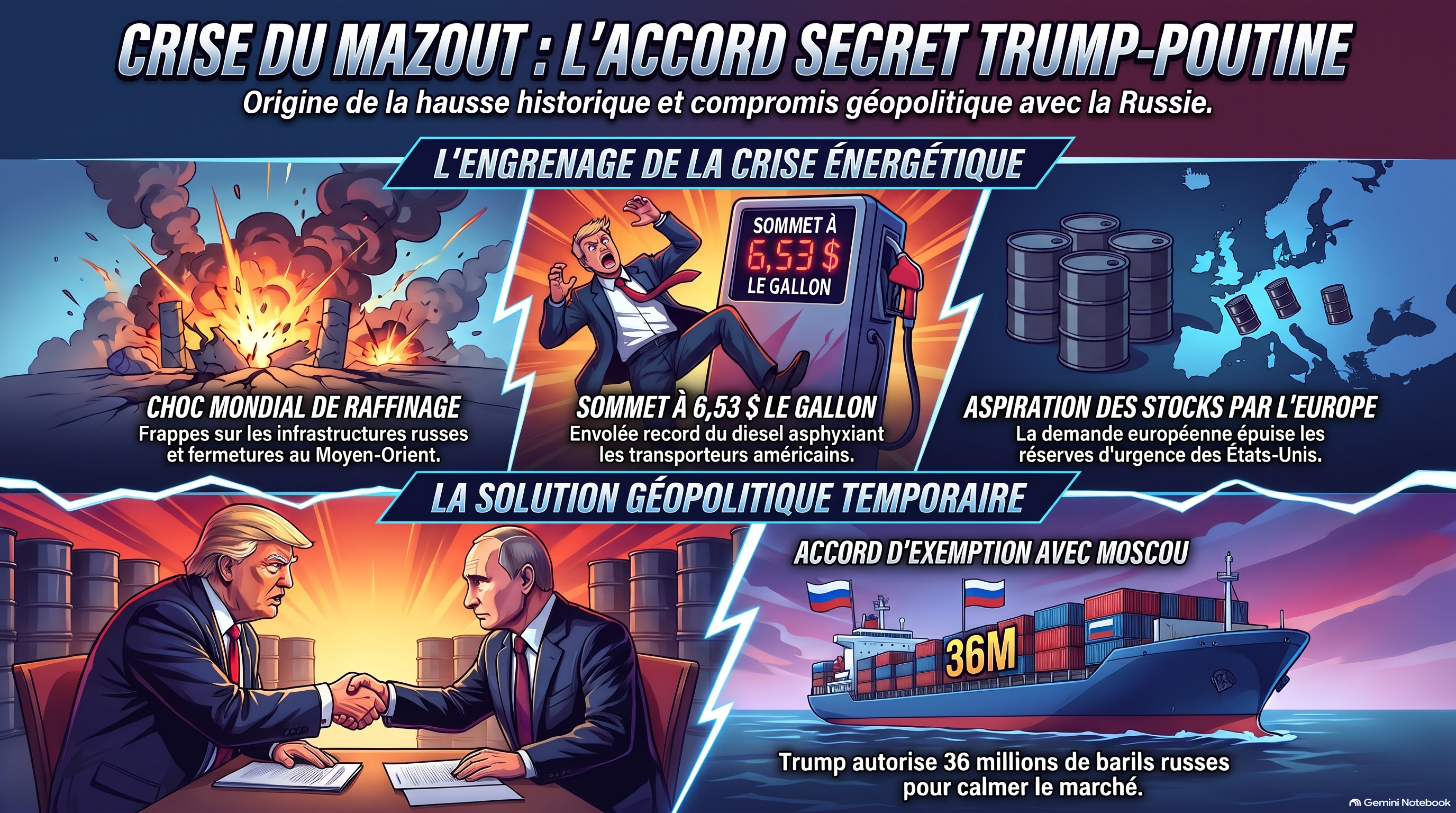
On October 9, 2026, just a few weeks before the crucial U.S. Congressional elections, an entirely improbable political and economic event took the world by surprise. U.S. President Donald Trump picked up his phone to speak directly with his Russian counterpart, Vladimir Putin. The objective of this emergency call? To secure the immediate shipment of millions of tons of Russian diesel to the United States and global markets—starting with a priority delivery of 300,000 tons.
On the very same day, the U.S. Department of the Treasury issued an emergency directive lifting sanctions and opening U.S. ports to the unloading of Russian diesel until April 2027.
To understand this 180-degree diplomatic U-turn, one must look at the dizzying explosion of U.S. gas pump prices. Since the beginning of 2026, the price of a gallon of diesel in the United States surged from $3.50 to a historic peak of $6.53. For truck drivers, this increase represented a devastating extra cost of about $500 per fill-up. Unable to absorb such a financial shock, 16 U.S. transport and freight companies were forced to file for bankruptcy in a single month.
Faced with such a logistical and political earthquake, a fundamental question arises: How did the world's leading producer of crude oil find itself forced to reach out to Moscow to avoid running on empty?
The Great American Diesel Paradox - Why Is the Top Global Producer Bordering on a Shortage?
To grasp the inner workings of this crisis, it is essential to distinguish between two fuels that are often confused but play radically different economic roles: standard gasoline and diesel (or heating oil).
Gasoline is primarily the fuel of individual consumption and daily convenience. If its price rises, households can adjust their travel habits. Diesel, on the other hand, is the true engine of production and the lifeblood of global logistics.
"Diesel is not a luxury fuel; it is the blood flowing through the circulatory system of the entire economy."
It powers the semi-trucks that supply supermarkets, the tractors and harvesters that gather wheat and corn, freight trains, cargo ships, as well as hospital emergency generators. This critical role explains why, while American gasoline capped around $4.50 a gallon, diesel continued its wild surge up to $6.53.
The American paradox lies in its unprecedented production figures:
- Crude oil production: Approximately 14 million barrels per day (an all-time world record).
- Diesel refining capacity: Over 5 million barrels per day.
- Domestic consumption: About 3.6 million barrels per day.
- Standard exports: 1.5 million barrels per day.
On paper, the United States holds a massive structural surplus, making it the world's leading exporter of diesel. Yet, its domestic consumers and economic actors found themselves suffocated by astronomical prices.
The Global Perfect Storm - How Two Global "Kitchens" Collapsed Simultaneously
Prior to the 2026 crisis, Russia and the Gulf states served as the two major "chefs" of global diesel, together supplying roughly 45% of seaborne diesel worldwide (according to International Energy Agency - IEA data). In 2026, these two core hubs were neutralized almost simultaneously.
Shock No. 1: The War in the Middle East (February 28, 2026)
The closure of the Strait of Hormuz paralyzed maritime flows. Although crude oil exports gradually resumed in September to reach 75% of their pre-war levels (stabilizing crude around $75 a barrel), ready-to-use refined fuels remained blocked. Middle Eastern refined product shipments collapsed from 4.7 million barrels per day before the conflict to under 1.9 million barrels per day in September.
Shock No. 2: Ukrainian Drone Strikes in Russia
Ukraine repeatedly targeted Russian refining infrastructure, destroying roughly 30% of the country's diesel production capacity. Production at Russian refineries dropped from 5.5 million to 3.8 million barrels per day. Facing this domestic shortage ahead of autumn harvests and winter heating demands, Moscow declared a full embargo on its diesel exports in July 2026.
To top it all off, China suspended its fuel exports in October 2026 to secure its own national reserves. The halt of Chinese exports removed an additional 1 million barrels per day from the market, effectively doubling the initial global deficit of 1 million barrels per day. This combined withdrawal plunged Western buyers into critical energy isolation.
Europe Siphons American Diesel and Dries Out the U.S. East Coast
Deprived of its traditional suppliers in the Middle East and Russia, Europe turned in desperation to the only remaining operational refining powerhouse: the United States.
In the summer of 2026, tankers leaving U.S. ports for international destinations increased by 50%, sending refined fuel exports soaring from 1.25 million to 2 million barrels per day. While Europe historically absorbed only 22% of U.S. diesel (with the remainder usually supplying South America and Mexico) it became its primary customer within months. By August 2026, the United States alone covered half of the European continent's total diesel imports.
This massive siphoning created a devastating logistical paralysis inside American borders:
- The Pursuit of Global Profit: Private U.S. refiners naturally favored international buyers willing to pay up to $220 per barrel of diesel on the global market (nearly triple the price of crude). To obtain fuel from local refineries, American truckers and farmers had to match these prohibitive international rates.
- Suffocation in the Northeast: The crisis hit major metropolitan areas like New York and Boston particularly hard due to their heavy dependence on heating oil for homes. Strategic emergency reserves in the region fell to 1 million barrels (barely five days of consumption) reaching their lowest historical level in 44 years.
Trump's Dilemma - Why Banning Exports Was a Bad Idea in Disguise
In late September 2026, amid rising voter anger, Donald Trump threatened to impose a outright ban on U.S. diesel exports. However, by October 2, the president made a dramatic reversal and officially abandoned the plan.
Economic advisors and experts from Oxford Economics laid out the fatal domino effect of such a decision:
- The European Rebound Effect: If the United States shut off the supply, diesel prices in Europe would immediately spike by 40% to 50%. Given that the U.S. imports $600 billion worth of goods, pharmaceuticals, and machinery from Europe annually, higher European production and transport costs would have instantly driven up the price of those imports for American consumers.
- The Logistical Bottleneck Trap: Most U.S. refineries are located in the South (particularly Texas). However, the U.S. lacks the necessary pipelines and a sufficient coastal shipping fleet to transport this excess fuel from the South to the Northern and Eastern states (which typically rely on maritime imports from abroad). Diesel trapped in Texas would have quickly saturated local storage tanks, forcing refineries to slow down or halt operations. A slowdown in refining capacity would have simultaneously reduced the production of standard gasoline and jet fuel, triggering a widespread price surge across all fuels on U.S. soil.
Caught in a bind, Donald Trump used the embargo threat as a diplomatic bluff. By brandishing the threat before the G7, he secured a commitment on October 2 from allies to release 100 million barrels of oil and refined products from emergency reserves over four months.
However, this plan was largely a illusion: out of those 100 million barrels, the share of refined diesel immediately available under IEA control amounted to only 20 million barrels, the equivalent of just five days of U.S. consumption. This temporary band-aid proved far too weak to curb the economic panic.
Corporate Greed and Inflation - Who Really Profited From the Crisis?
Behind this insurmountable logistical equation lay another, even more unsettling reality: the colossal windfall profits recorded by the oil industry at the expense of consumers.
In the United States, where 70% of goods and food are transported by truck, the road freight sector absorbed a massive extra cost of $35 billion in just six months. The average cost of a standard freight haul in a state like Nevada rose from $1,000 to $1,900.
These logistical costs were passed directly onto supermarket shelves. Inflation reignited in September, forcing the Federal Reserve (Fed) to raise interest rates into a 3.75% to 4% range—a first in three years.
Yet, this crisis was not caused by a spike in crude oil (which increased by only about 40%), but by runaway refining margins (crack spreads).
In normal times, the gap between the price of a barrel of crude and that of refined diesel caps at around $20. During the 2026 crisis, this gap surpassed a surreal $100 per barrel.
The "Big Three" American refining giants (Marathon Petroleum, Valero, and Phillips 66) exploited this distortion to their advantage. While transport companies filed for bankruptcy and households accumulated debt, the Big Three pulled in $12.6 billion in net profits over three months, marking their best financial performance in nearly four years.
Why didn't the American president impose price caps or a windfall tax on these profits? Quite simply because the executives of these major refining groups were among the top financial donors to his campaign.
The Secret Deal with Putin - An Electoral Illusion and a Victory for Moscow
Isolated in a political dead end just days before the election, Washington was forced to negotiate with its primary geopolitical adversary. As early as September, Donald Trump had paved the way by asking Ukrainian President Volodymyr Zelensky to immediately cease drone strikes against Russian refineries, arguing that destroying these plants was raising gas prices for American voters.
For its part, Russia found itself in a unique position in the autumn, as revealed by analyses from the Carnegie Endowment and The Moscow Times: before the Ukrainian strikes, its refineries were producing more than double its domestic needs. Once the autumn harvests concluded, internal Russian consumption dropped by 75% (falling to a quarter of its usual level), releasing a monthly surplus of 7.5 million barrels of diesel without sufficient storage capacity. Russian oil companies were choking under this excess, but were paralyzed by their own government's embargo and U.S. sanctions that forced them to rely on an expensive "shadow fleet" with steep discounts.
This is where the interests of Washington and Moscow aligned.
Terms of the October 9, 2026 Deal:
- Russian Commitment: Gradual release of 36 million barrels of diesel (2.2 million in October, 3.7 million in November, followed by 7.5 million monthly thereafter).
- U.S. Concession: The U.S. Treasury suspends sanctions on Russian diesel and permits its transport and unloading in global and U.S. ports until April 2027.
- Moscow's Response: On October 10, Russian Deputy Prime Minister Alexander Novak officially announced the easing of the Russian embargo, targeting exports of up to 26 million barrels per month.
A Disappointing Real-World Impact
The 36 million barrels promised by Russia represented only 10 days of U.S. consumption (and barely a single day on a global scale). The portion delivered in November (3.7 million barrels) covered only 4% of monthly U.S. consumption and 13% of the global monthly deficit.
Following the announcement, the price per gallon in the United States fell by only a few cents, settling at $6.18. Forecasts by the U.S. Energy Information Administration (EIA) indicate that diesel will remain above $5 a gallon through the end of 2026.
The Winners' Scorecard:
- Donald Trump: Obtained a short-lived political sedative to reassure his voter base of farmers and truckers before the election, while slowing stock market speculation to prevent $7 or $8 diesel on Election Day.
- Russia and Vladimir Putin: Emerged as the major economic and geopolitical winners of the operation. Russian oil companies pocketed approximately $400 million from the first tranche alone by selling at top international prices. On the diplomatic front, Moscow shattered the U.S. sanctions regime, forcing Washington to officially legitimize Russian energy sales in full view of its bewildered allies.
Assessment and an Open Question
The 2026 diesel crisis served as a striking demonstration of the vulnerability of major powers to globalized energy markets. The intertwining of international flows, regional logistical bottlenecks, and the pursuit of profitability by refining giants were enough to force the world's leading oil producer to solicit emergency help from its greatest geopolitical rival. For short-term electoral imperatives, the strictness of sanctions diplomacy ultimately gave way to the reality of the price at the pump.
What is your analysis? Does the deal struck between Donald Trump and Vladimir Putin represent an indispensable pragmatic move to protect the purchasing power of American citizens, or does it mark the first step toward the definitive undoing of the Western sanctions regime?