Listen up: Your late-night TikTok scrolls, your group's chaotic group chat memes, that one viral AI filter making everyone look snatched — it's all powered by a frenzy of investment that's rewriting global money flows faster than a trend goes viral. As of mid-2026, AI isn't just some flashy gadget; it's the heavyweight champ driving capital expenditure, propping up GDP numbers, and making Big Tech's balance sheets look like they mainlined espresso.
Why now? Simple: The global economy's been limping through slowdowns, trade wars, and geopolitical headaches. Enter AI infrastructure — data centers, chips, power plants — acting like economic CPR. The IMF credits this boom with offsetting drags from conflicts and fragmentation, lifting 2026 global growth forecasts to around 3.3%. In the US, AI-related investments in servers, software, and energy are fueling a massive chunk of GDP growth. Hyperscalers like Microsoft, Amazon, and Google are dropping hundreds of billions on GPUs and facilities.
But here's the "Why?" we should all be yelling: Why is this concentrated in a handful of players and regions, and who actually benefits long-term?
The Investment Engine: Follow the Trillions
Major tech giants are in full sprint mode. Morgan Stanley projects nearly $3 trillion in AI-related infrastructure spending globally by 2028, with hyperscalers' capex ballooning toward $800 billion in 2026 alone. We're talking semiconductors (hello, Taiwan and South Korea), energy grids, and massive data centers that guzzle power like it's unlimited.
This isn't random. Generative AI needs insane compute, training one big model can cost as much as running a small country's electricity for months. Falling chip costs and hype cycles created a feedback loop: more investment, more capability, more hype, repeat. Analysts compare it to the 1990s internet boom, but with higher stakes because the barriers (compute, energy, talent) are sky-high.
Why the concentration? Incentives are misaligned toward short-term wins for elites. A few US and Asian giants dominate the stack — from Nvidia chips to cloud platforms. This creates "new growth hubs" in places like Taiwan, South Korea, Malaysia, and the US, while raising red flags on energy consumption, supply chain chokepoints (think rare metals), and bubble risks. IMF notes warn of over-investment and potential valuation resets if productivity miracles don't materialize fast.
It's giving monopoly energy, but with a greenwashed bow. Data centers already sip 1-2% of global electricity; projections scream higher, rivaling entire countries. Who pays the environmental bill while shareholders cash out?
The Stakes for Africa and the Middle East: Opportunity or Extraction 2.0?
Now zoom out to regions that didn't invent the iPhone but live with the fallout of global tech. Africa and the Middle East aren't passive spectators, they're eyeing the table, but the game's rigged toward those with capital, stable grids, and geopolitics on their side.
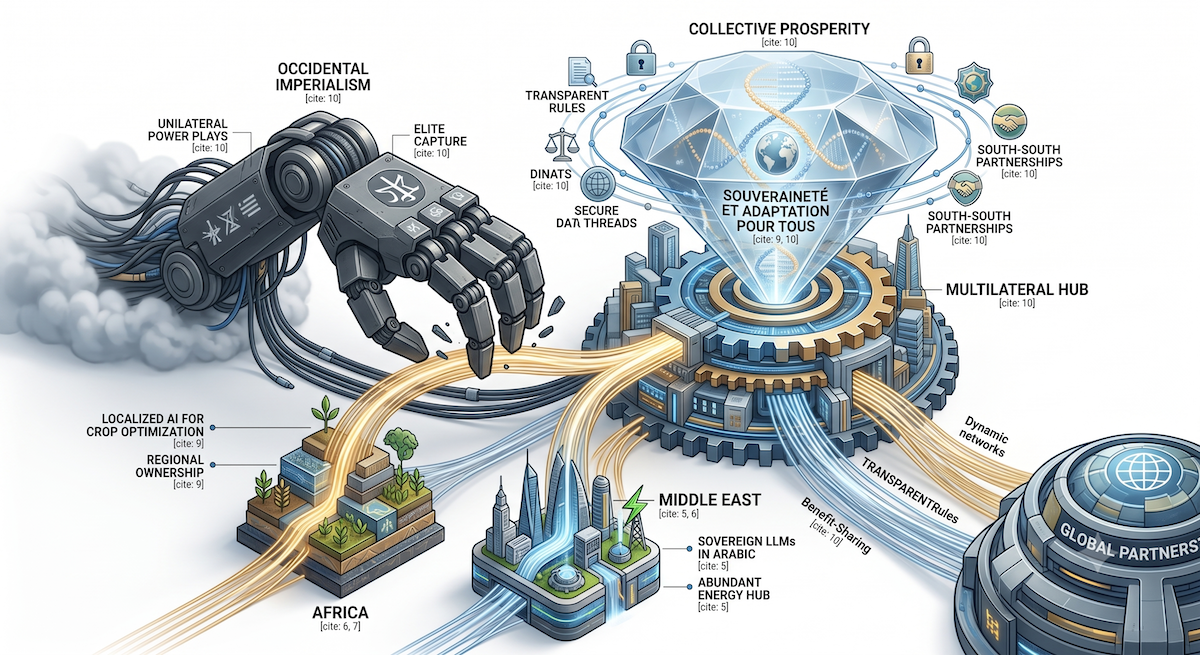
Middle East Glow-Up (with caveats): Gulf states are all-in. UAE and Saudi Arabia are leveraging oil wealth, cheap(ish) energy, and strategic location to become AI hubs. Saudi's $100 billion "Project Transcendence," UAE's Stargate-style campuses, and partnerships with Microsoft, Google, and Oracle signal serious moves, but - de facto - under American dependency. PwC estimates the region could snag 2% of global AI benefits by 2030 — that's $320 billion. Think sovereign LLMs in Arabic, data centers powered by abundant energy, and positioning as a bridge to Africa and Asia.
Why? Diversification from oil, Vision 2030-style bets, and soft power plays. Gulf capital + US tech stack = influence export. But "Why the fine print?" Extreme heat tanks cooling efficiency, water scarcity is brutal for data centers, and reliance on imported chips keeps them tethered to Big Tech supply chains. Conflicts in the region could torch infrastructure dreams overnight.
Africa: Massive Potential, Brutal Barriers: McKinsey and others project AI could add $1-1.5 trillion to Africa's economy by the mid-2030s, with GenAI unlocking tens of billions yearly in sectors like agriculture, healthcare, and finance. Initiatives like Africa's first NVIDIA-powered AI factories (shoutout to Cassava Technologies) and UAE's $1 billion push for AI in Africa show cross-border ambition.
But reality check: Most of the continent has unreliable grids, low data center capacity (emerging economies outside China hold <10% globally despite half the internet users), and talent gaps. Energy access is patchy, perfect for leapfrogging with smart AI grids, but a nightmare for training frontier models.
Why the disparity? Incentives favor capital-rich players. Without multilateral guardrails, Africa risks becoming a raw data mine or cheap inference hub — extractive patterns repeating colonialism's playbook, just with algorithms. Supply chain vulnerabilities (gallium from China, anyone?) and energy hunger could exacerbate inequalities. Positive flip: Localized AI for crop optimization, predictive maintenance on grids, or Arabic/African language models could empower everyday people if ownership stays regional.
Global patterns scream caution: Big Tech's concentration means profits flow north/west, while environmental and social costs land elsewhere. Energy demands could strain African grids or Middle Eastern water resources, widening the digital divide instead of closing it.
Multilateralism or Bust: Time for Transparent Rules
This isn't anti-AI doomposting ; AI can boost productivity like the digital revolution did. But only if we demand better. Transparent, cross-border standards on energy use, data sovereignty, ethical deployment, and benefit-sharing aren't buzzwords; they're survival tools for the Global South. Imagine collaborative AI hubs funded jointly, open-source models prioritizing local languages, and investments tied to real job creation and sustainability, not just elite capture.
Why push multilateralism? Because unilateral power plays by tech giants and petrostates concentrate gains among insiders, leaving the rest scrolling through the consequences. Documented conflicts of interest (hyperscalers shaping policy while gobbling infrastructure) demand scrutiny. Hopeful collective alternatives exist: South-South partnerships, like UAE-Africa links, done right.
AI's investment surge is real, transformative, and double-edged. It's accelerating growth in the right spots while exposing fractures everywhere else. The question isn't whether AI reshapes the world, it's whose world it builds. Will Africa and the Middle East ride the wave as equals, or watch trillions flow past while powering someone else's future?
So, reader, if compute is the new oil, whose wells are we really drilling, and who gets to drink the water when it runs dry?