AI: A Major Driver of a Changing Medical Field.
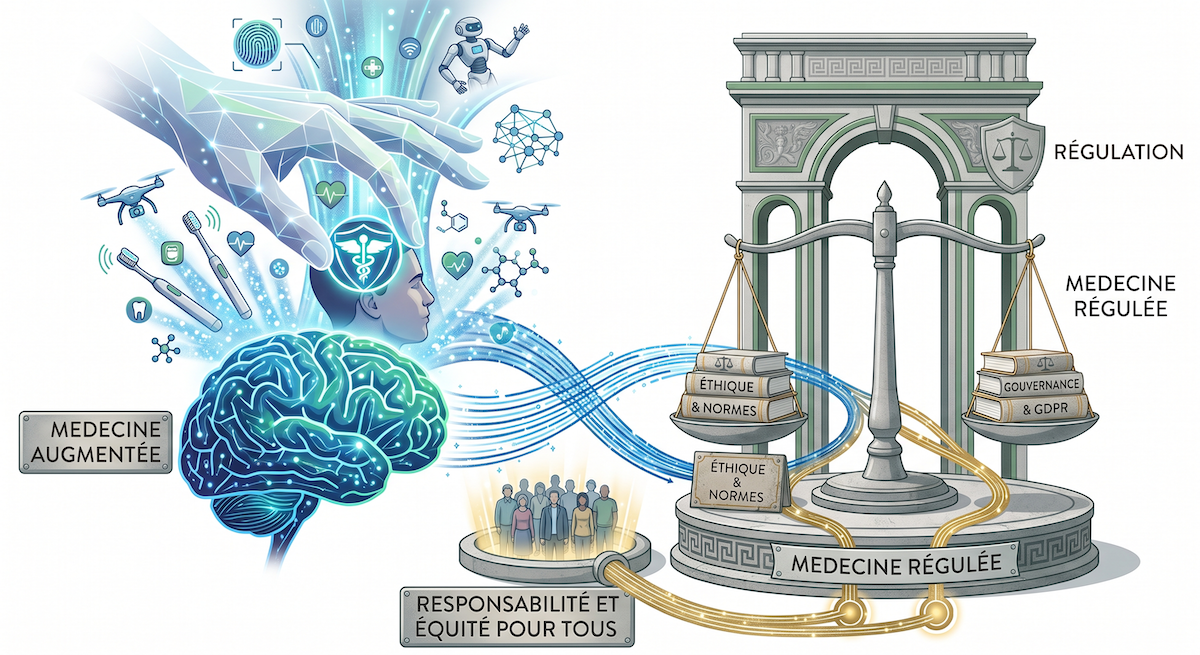
Artificial intelligence (AI) is no longer a distant promise: it is now making its way into clinical practice, prevention, and healthcare management. By enabling the analysis of massive volumes of data in a matter of moments, AI offers unprecedented opportunities to speed up diagnoses, personalize treatments, and optimize care pathways. But this revolution also raises risks (errors, bias, dependency) and requires a stronger regulatory and ethical framework. Balancing technological promise with safeguards, medicine is thus entering an “augmented and regulated” era.
AI for Diagnosis and Decision-Making.
AI tools are already assisting medical practice at various levels. Some biometric devices use facial recognition and microsignals to generate health indicators. NuraLogix’s Longevity Mirror, for example, is a system capable of analyzing micro-movements, skin tone, and breathing to provide an overall assessment of physiological status. These technologies, which currently serve as assessment aids, demonstrate how AI can enrich the field of clinical observation without replacing it.
At the same time, medical chatbots, such as MedGPT developed by Synapse Medicine, aim to support healthcare professionals by synthesizing official references (HAS, ANSM, Thériaque, etc.) and offering decision-support tools tailored to the French regulatory framework. These tools speed up access to information and can reduce errors in interpreting documentation, while remaining designed to complement—not replace—professional judgment.
Risks and Limitations: Hallucinations, Bias, and Dependence?
Despite their advantages, AI systems have limitations that the scientific community and organizations such as Inserm regularly highlight. Three major risks require constant vigilance.
Errors or “hallucinations.” Some models generate inaccurate or fabricated responses while presenting them as reliable. In medicine, such erroneous output can lead to inappropriate interpretations if not verified by a professional.
Algorithmic biases. AI systems learn from historical and heterogeneous data. If these datasets are incomplete or reflect discriminatory practices, the model may perpetuate—or even amplify—biases related to gender, origin, or other patient characteristics. Recent studies show that these phenomena are not merely theoretical and require strategies for data cleaning, balancing, and validation.
Growing Dependence. As these tools become more powerful, the temptation to rely on them systematically grows. Overuse risks weakening clinical critical thinking and eroding human medical reasoning. Systems must therefore remain decision-support tools with clear procedures for human validation.
Predictive Medicine and Biomarkers: The Era of Anticipation.
AI now combines biomarkers and predictive analytics to shift from reactive medicine to anticipatory medicine. Home sensors and connected devices incorporate functions once reserved for laboratories.
Everyday objects as sensors. The Halo (Y-Brush) smart toothbrush, unveiled at CES 2026, illustrates this trend: by analyzing the composition of breath, the device claims to detect biomarkers associated with a wide range of potential conditions. Similarly, sophisticated bathroom scales like the Withings Body Scan 2 transform weighing into a multivariate health checkup, analyzing dozens of biomarkers related to metabolism, the cardiovascular system, and body composition.
Targeted interventions. Some innovations no longer stop at observation; they offer intervention loops. Neuromind, for example, combines neurofeedback, virtual reality, and cognitive therapies to modify users’ cognitive or emotional states through neuroplasticity. These systems open up new therapeutic possibilities, particularly in psychiatry and rehabilitation, but raise questions about long-term clinical evaluation and liability.
Cellular mapping. At the fundamental level, initiatives such as the Human Cell Atlas aim to map the billions of human cells to understand their roles, interactions, and evolution. Integrating this massive dataset with AI promises advances in our understanding of diseases and in the development of personalized treatments.
Home Healthcare: The New Frontier.
The management of chronic diseases is gradually shifting from hospitals to the home, thanks to connected technologies and therapeutic applications. Therapeutic virtual reality, initially used in hospitals, can now be deployed at home through supervised programs—such as Healthy Mind—that have demonstrated positive effects on pain, anxiety, and quality of life. Continuous monitoring allows for early adjustments to care plans and helps prevent health deterioration.
Home technologies are not limited to medical devices: acoustic solutions (e.g., Sonaid) use sound analysis to detect falls, calls for help, or abnormalities in less than ten seconds, without requiring the person to wear any devices or causing them to feel stigmatized. These innovations promote independence among older adults and reduce the burden on healthcare systems, provided that confidentiality and security are ensured.
Aging, Prevention, and Social Acceptability.
Population aging is a powerful driver of innovation in e-health. Demographic projections indicate that older adults will make up a growing share of society, and a large majority of older adults wish to age in place. Connected technologies address this aspiration by offering monitoring, assistance, and prevention tools, but their deployment requires special attention to usability, acceptability, and user training.
Cybersecurity and data sovereignty: strategic challenges.
The digitization of healthcare makes health data a strategic target. Healthcare professionals and patients agree on the benefits of these technologies but express strong concerns about data protection. According to recent surveys, a majority of healthcare providers say they support digital innovations, while expressing widespread doubts about the security and confidentiality of medical information.
Health Data: Opportunities and Risks. Every medical consultation and every connected device generates sensitive data: genetic information, diagnostic results, and health behaviors. This data holds significant economic potential and is of a highly personal nature, making it a target for cyberespionage, fraud, or unauthorized use.
The Tension Between Innovation and Protection. High-performance algorithms require large volumes of data for training. However, the availability and quality of this data vary, and its concentration among certain actors raises questions of sovereignty. Without robust frameworks, AI in healthcare risks increasing inequalities and eroding patient trust.
Regulation and Standards. In Europe, legislation governing AI (the AI Act) and data protection (the GDPR) seeks to establish guidelines for high-risk uses, including certain applications in healthcare. The phased implementation of these regulations requires developers and healthcare institutions to incorporate compliance, auditability, and traceability from the design phase onward.
Toward Augmented and Responsible Medicine: Recommendations.
For AI to deliver on its promises without compromising safety and equity, several areas are priorities.
Governance and transparency. Establish independent validation bodies, publish the performance and limitations of algorithms, and ensure the traceability of data and decisions.
Data quality. Invest in the collection of representative, ethically and geographically diverse datasets, with rigorous labeling processes to reduce bias.
Training and skills development. Integrate digital literacy and the critical use of AI into the training of healthcare professionals to avoid passive dependence on tools.
Security and sovereignty. Strengthen cybersecurity measures, encourage local or publicly controlled storage and processing capabilities, and clarify the conditions for data access and use.
Continuous clinical evaluation. Promote robust longitudinal studies and clinical trials to measure the long-term effects of AI systems on health and inequalities.
AI: A Tool That Must Be Regulated to Improve Care.
Artificial intelligence is profoundly transforming medicine: accelerated diagnosis, personalized care, and new preventive and therapeutic tools. But for this transformation to truly benefit patients, it must be accompanied by rigorous scientific, legal, and ethical oversight, as well as sustained investment in data quality, security, and professional training. The medicine of tomorrow is taking shape as “augmented” by AI, provided that it remains “guided” by clear principles of accountability and equity.