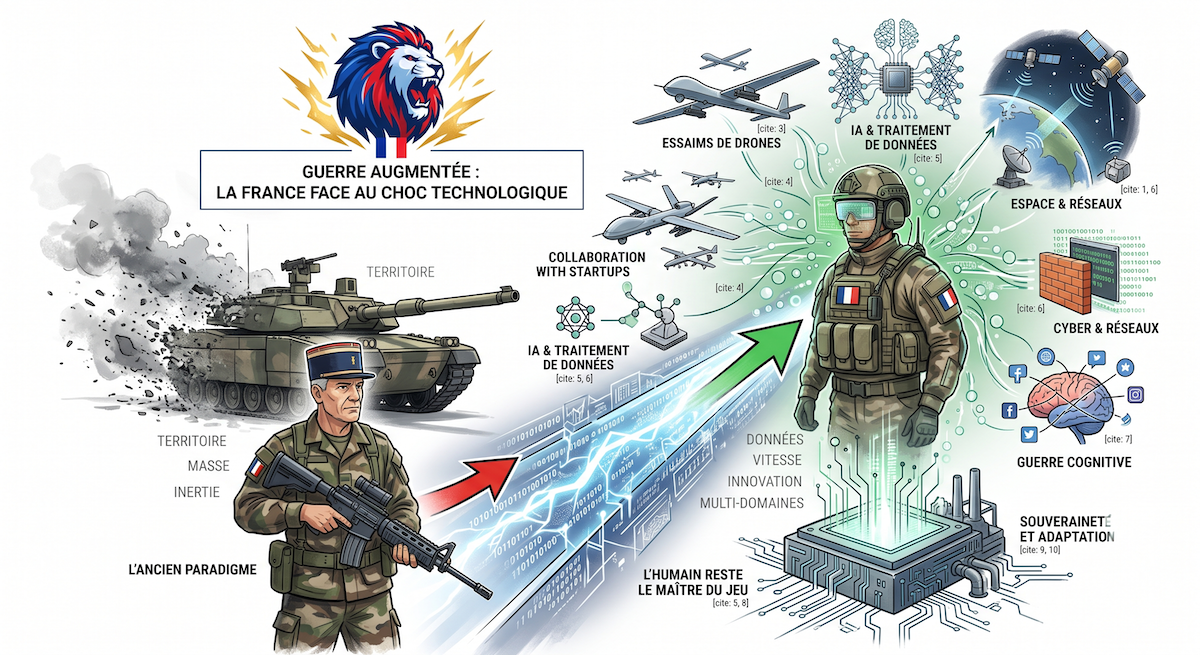
For a long time, war was conceived in terms of territory, front lines, and material superiority. Today, that perspective already belongs to a bygone era. Modern combat takes place in a far vaster, more diffuse, and more unstable space: a space where every movement can be detected, every communication intercepted, every narrative contested, and every decision accelerated by machines. In Ukraine, this transformation has unfolded before our eyes with rare brutality. The conflict there has served as a full-scale laboratory for a military revolution that extends far beyond the borders of Eastern Europe.
What this transformation reveals is not so much the advent of new weapons as the emergence of a new logic of war. Armies no longer confront one another solely with tanks, aircraft, or artillery. They observe, track, disrupt, and wear each other down in an environment saturated with sensors, data, and continuous learning loops. In this new era of conflict, victory increasingly belongs to those who can see further ahead, make decisions faster, and adapt their capabilities almost in real time.
Ukraine: A Brutal Reflection of Future Conflict
Ukraine has become the clearest illustration of what 21st-century warfare might look like. Every day, the front lines confirm a reality that can no longer be ignored: the battlefield is now so transparent that it has become nearly impossible to conceal troop movements, logistical gatherings, or artillery positions for any length of time. Reconnaissance drones, satellite imagery, electromagnetic sensors, and digital communications have transformed warfare into an environment of near-constant visibility.
This constant exposure is profoundly changing tactical approaches. Units are spreading out more, changing locations frequently, reducing their electronic signatures, and seeking to evade detection that has become constant. In this context, survival depends less on brute force than on the ability to camouflage oneself in a digital landscape that has become hostile. High-performance equipment that is too slow to deploy, too electromagnetically noisy, or too inflexible in its use can quickly become a target.
The conflict in Ukraine has also shown that military innovation no longer flows solely from major defense contractors down to the battlefield. It now flows rapidly back from the front lines to the designers. A technology emerges, is tested, refined, and then replaced by an improved version—sometimes in just a few weeks. Obsolescence cycles have shortened at an unprecedented rate. What the war in Ukraine highlights, therefore, is a disturbing reality for traditional militaries: in a high-intensity conflict, the advantage belongs to those who learn the fastest.
The Rise of Drones
No other tool illustrates this transformation better than the drone. Simple, flexible, and relatively inexpensive, it has become one of the most feared instruments of contemporary conflict. Whether for observation, fire correction, strikes, harassment, or electronic warfare, the drone has established itself as a central component of modern combat.
Their value lies not only in their versatility but also in their ability to achieve greater impact at low cost. Where heavy assets were once required for observation, targeting, or neutralization, all that is sometimes needed now is a lightweight aircraft, a camera, a trained operator, and an effective data link. Swarms, in particular, introduce a new dimension. Several small drones can overwhelm defenses, complicate detection, and force the enemy to spread its resources thin.
But the challenge lies not only in the device itself. It lies in the ecosystem surrounding it: navigation software, image processing, secure communication, electronic countermeasures, rapid maintenance, local production, and continuous adaptation. In other words, the drone is not just a weapon; it is the symbol of a war that has become profoundly systemic. In such an environment, superiority no longer depends solely on the number of available platforms, but on the quality of the digital ecosystem that makes them operational.
Artificial Intelligence Takes the Front Lines
Artificial intelligence is also emerging as a game-changer. It enables the faster processing of data volumes that would be impossible to handle manually, assists in target detection, prioritizes threats, optimizes certain command functions, and improves intelligence operations. In an environment saturated with information, this increase in speed is decisive.
However, AI is not a magic wand. Its effectiveness depends on the quality of the data, the robustness of the systems, and the framework within which it is used. In a military context, the stakes are high, as a classification error, a detection bias, or a misinterpretation can have immediate and severe consequences. This is why most serious military doctrines still emphasize a fundamental principle: AI must assist decision-making, not replace it entirely.
This issue of human control lies at the heart of the ongoing military revolution. The armed forces want to harness the power of machines without relinquishing decision-making authority. The soldier is not disappearing; his role is changing. He is no longer content merely to fire a weapon or maneuver. He is becoming a systems operator, a workflow manager, a prioritizer, and a decision-maker in a technology-accelerated environment. The challenge, therefore, is not merely to increase automation, but to automate without dehumanizing the process.
France at a Turning Point.
Faced with this new reality of warfare, France has embarked on a profound transformation. The goal is clear: to maintain strategic autonomy in a world where military superiority increasingly depends on mastery of critical technologies. This requires investment in sensors, software, secure networks, high-performance computing, space, electronic warfare, and resilient command systems.
One of the defining features of this evolution is the growing openness toward the civilian ecosystem, particularly toward startups. For a long time, defense innovation relied primarily on major prime contractors and long-term programs. Now, the armed forces are also seeking rapid, agile, and modular solutions. Start-ups bring prototyping capabilities, a culture of iteration, and familiarity with emerging technologies that usefully complement more cumbersome structures.
This collaboration is not merely a passing trend. It addresses a strategic necessity. In an environment where threats evolve at breakneck speed, it is essential to be able to test, correct, deploy, and start over without waiting for excessively long industrial cycles. The French defense sector is therefore seeking to adopt an innovation model capable of absorbing the pace of change rather than being overwhelmed by it.
The sky, orbit, and networks.
Modern warfare is not confined to the ground. It now extends to space and cyberspace, two domains that have become central to the conduct of operations. Satellites provide communication, navigation, observation, and intelligence. Digital networks ensure coordination, command, and data flow. Consequently, attacking or protecting these infrastructures directly impacts an army’s ability to see, understand, and maneuver.
Space surveillance is thus taking on growing strategic importance. It enables better anticipation of movements, secures orbital assets, and reduces vulnerability to hostile actions. At the same time, high-performance computing has become indispensable for processing data, modeling scenarios, simulating behaviors, and supporting operational decisions. In other words, military power is also built in data centers, behind screens, in lines of code, and at the heart of invisible networks.
Cyberspace adds an additional dimension—one that is more discreet but just as decisive. There, attacks can disrupt communications, compromise critical systems, steal sensitive information, or manipulate data flows. In a modern conflict, cyber offensives are not a side issue: they are an integral part of military operations. They can prepare for an action, support it, or extend its effects far beyond the visible front lines.
The Battle of Perceptions
Alongside the war of systems, there is now a war of minds. The cognitive dimension of conflict has become unavoidable. Disinformation, manipulation of public opinion, influence campaigns, rumors amplified by social media, and information saturation strategies make up a new arsenal designed to influence perceptions rather than physical bodies.
This war aims to undermine trust, divide, disorient, and impose a narrative favorable to the adversary. It can affect the general public, elected officials, the media, the armed forces themselves, and allies. In this arena, the speed at which information circulates becomes a double-edged sword. A viral video clip can destabilize more than an official statement can reassure.
For France, this reality requires thinking about defense beyond the military in the strict sense. Protecting the country also means protecting its collective ability to distinguish truth from falsehood, to resist manipulation, and to maintain a foundation of democratic trust. In cognitive warfare, social resilience becomes a component of sovereignty.
The Enhanced, but Not Replaced, Soldier
One of the most sensitive debates surrounding this transformation concerns the role of the soldier. Current technologies make it possible to enhance soldiers’ capabilities: better vision, better information, better protection, and better coordination. They can also alleviate certain physical constraints and reduce reaction times. But they raise a major question: How far should we go with automated assistance before risking the dilution of human responsibility?
France, like many modern militaries, seeks to maintain a delicate balance. It is not a matter of pitting humans against machines, but of defining a healthy relationship between the two. Technology must enhance the soldier’s effectiveness without reducing him or her to a mere cog in an opaque system. In the most sensitive operations—particularly when lethal force is involved, human decision-making remains a political, legal, and moral imperative.
This requirement marks a fundamental difference between civilian automation and military automation. In industry, the goal is often to replace repetitive tasks. In defense, the challenge is to enhance performance without sacrificing judgment. The modernization of the armed forces cannot, therefore, be conceived solely in terms of power; it must also be considered in terms of responsibility.
Sovereignty as the Capacity to Adapt.
Fundamentally, the current military revolution is redefining what it means to be sovereign. In the past, sovereignty was measured by the possession of territory, an army, and a defense industry. Today, it also depends on the ability to master data, algorithms, satellites, sensors, software, and critical supply chains.
In this new era, military strength is built as much on the speed of innovation as on the sheer volume of equipment. A country that can produce quickly, integrate quickly, and learn quickly has a real advantage. A country that remains trapped by its industrial inefficiencies or technological dependencies risks rapid decline.
It is precisely to avoid this scenario that France is accelerating its transformation. It is preparing for multi-domain warfare, where digital superiority, industrial responsiveness, and mastery of cyber and digital environments are becoming the new pillars of power. The challenge is immense, but it is clear: in the conflicts of tomorrow, victory will belong to those who can combine technology, speed, and human decision-making.