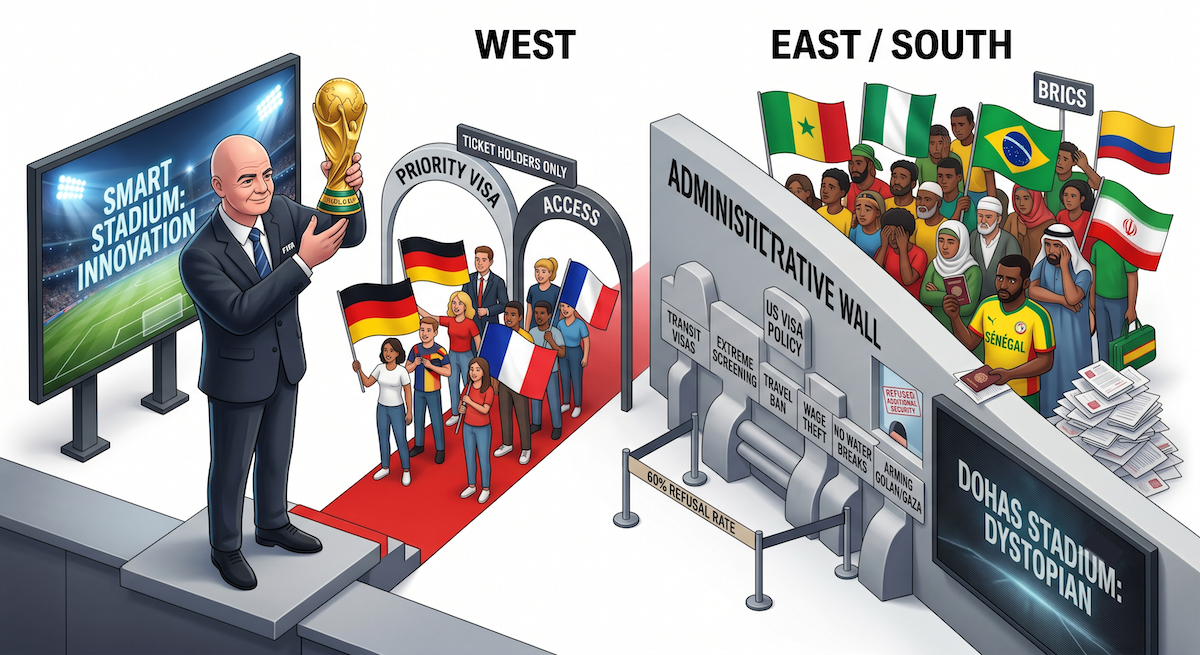
We were promised the land of the free. Instead, we're rediscovering the land of double standards. The beautiful game is rolling onto American soil, co-hosting with Canada and Mexico. The prospect is enticing. Yet, upon closer examination, one question arises: where has the moral compass of the international community gone?
While FIFA and the Western media celebrate the "greatest World Cup in history," let's remember the treatment meted out to others. Because here, what was once an absolute red line suddenly becomes a mere logistical detail.
1. Mass surveillance, but the "smart stadiums" version.
In Russia, they talked about "profiling fans." In Qatar, they denounced facial recognition in stadiums. The technology used by the organizing committee was dubbed a "Big Brother" tool by Amnesty International.
By 2026, North American stadiums, notably MetLife Stadium and SoFi Stadium, are temples of biometric surveillance, developed by companies like Clearview AI, a company fined €30.5 million in Europe for illegally collecting facial data, but perfectly legal in its home country. FIFA will even test an AI-based video assistant referee (VAR) system there, with body cameras on referees and automated SAOT alerts.
What was dystopian in Doha becomes "innovative" in Dallas. The same security system simply changes its name: here, it's not social control, it's "streamlining the spectator experience."
2. Invisible but still exploited workers
Qatar was the scene of a global media trial concerning the conditions of migrant workers, with death figures endlessly debated, ranging from 400 to several thousand according to The Guardian.
Today, who is talking about American construction sites? A study by the Economic Policy Institute reveals that immigrant construction workers in the United States experience a minimum wage violation rate twice the national average and that wage theft is systemic. In Texas, the law prohibits cities from imposing mandatory water breaks on construction workers, even when temperatures soar to 45°C (113°F). These workers are of no interest to anyone. They aren't building stadiums in an emirate; they're building them in a democracy.
3. Hybrid Warfare and Mandatory Patriotism
Russia's invasion of Ukraine led to its immediate exclusion from the 2022 World Cup qualifiers, in the name of "peace through sport." A firm and widely praised decision.
In 2026, the United States hosted the world while simultaneously supplying weapons to Israel in the context of the war in Gaza, where the death toll exceeded 50,000 and sports infrastructure was destroyed. The Palestinian Football Federation officially requested Israel's suspension from FIFA in May 2024, a request that was quietly ignored.
We are still waiting for Gianni Infantino's (FIFA President) statement denouncing the "geopolitical circumstances" of his own host country.
4. Visas Are Not a Privilege, They Are a Weapon
We have been told repeatedly that the World Cup is a celebration for the people. But in 2026, some nations will have to prove their worth before being allowed to set foot on American soil. Not German or French fans. They'll be welcomed with barbecues in the fan zones. No. Fans, journalists, and even players from countries targeted by Washington will have to prove their worth.
While Gianni Infantino talks about "football uniting the world," the American administration is imposing a grueling process on several qualified nations. A double standard that begins even before kickoff.
5. Senegal’s Anticipated Humiliation
Senegal, the 2022 African champions and a sure bet for the final stages of the tournament, could arrive in the United States without its popular support. Why? Because Senegalese citizens are subject to the most restrictive and humiliating visa policy imaginable.
Unlike fans from the European Union or Japan, Senegalese nationals must obtain not only a standard tourist visa, but also a transit visa, even for just a few hours in New York or Atlanta—a costly formality with an extremely high refusal rate. Worse still, the U.S. State Department classifies Senegal among the countries whose citizens are subject to "additional security checks" that can take several months, with no guarantee of a response before the opening match.
As a result, in 2022, the B1/B2 visa refusal rate for African nationals ranged from 30% to 60% depending on the consulate, with Dakar recording a refusal rate of nearly 58%. Translation: More than half of Senegalese football fans could be banned from stadiums before they've even bought their plane tickets.
Who's speaking out? Western federations are remaining silent, as they won't have this problem.
6. Iran: The Qualified Team Washington Doesn't Want to See
Iran was one of the most spectacular teams at the 2022 World Cup. In 2026, its presence is a thorn in the side of the American administration.
Since 2017, the United States has imposed a broad travel ban on Iranian nationals, under the pretext of a "terrorist threat." Exemptions for sporting events are discretionary. In short: every Iranian player, staff member, journalist, and fan must negotiate their entry on a case-by-case basis, with no guarantee of obtaining a visa in time. FIFA did try to negotiate a humanitarian sports corridor, but the US Congress, controlled by lawmakers hostile to Tehran, threatened to block any collective exemptions. Yet, 10 days before the opening match against New Zealand on June 15, the Iranian players finally received their visas.
In 2022, Russia was banned from the World Cup for military invasion. In 2026, the US effectively banned Iran through administrative paperwork for seven months, right up until the last minute.
The threat looms over other delegations from the "Global South." Senegal and Iran are just the tip of the iceberg of American punitive soft power:
- Nigeria: "Extreme screening procedures"
- Haiti: Travel ban June 2025, rare exceptions
- Sudan, Yemen: Unilateral US sanctions, transit visas virtually impossible
- Iranians/Syrians, dual nationals: Blocked by random checks, Executive Order 13780 never fully repealed
- Brazil, Colombia, Egypt: Immigrant visa suspension for 75 countries since January 2026
7. Visa blackmail: a geopolitical tool disguised as a formality
Let's call a spade a spade: by conditioning access to the country on political criteria, the United States is turning the World Cup into a tool of coercive diplomacy.
On January 14, 2026, Trump indefinitely suspended the processing of immigrant visas for 75 countries, including Brazil, Colombia, Egypt, Senegal, Nigeria, and Iran. But on January 20, the State Department launched the FIFA Priority Appointment System to fast-track visas for fans with tickets. Translation: privileged fans get priority, others wait—and many will never receive a response.
As the UN Special Rapporteur on racism points out, "US visa policy is structurally discriminatory toward countries of the Global South." Imagine Senegal winning the 2025 Africa Cup of Nations final, their fans chanting "Go Lions!" in front of their screens, not by choice, but because the American embassy has deemed them "at risk of non-return."
If tomorrow a Gulf state or Russia were to impose even 10% of these restrictions, the West would cry foul. But because the host country is an ally, FIFA turns a blind eye and newsrooms put away their calculators.
8. The Double Standard Verdict
The problem isn't criticizing Qatar, Russia, or others. The problem is that the rules are flexible, and they always bend in the same direction: that of the powerful.
As sports sociologist Jean-Baptiste Guégan analyzes: “There is a geopolitics of emotion. We don't react with outrage to the same deaths, nor to the same laws, depending on which diplomatic camp we belong to.” In 2026, prepare for media coverage that will focus on popcorn, halftime shows, and advanced technology. But not a word about anything else. It will be a sanitized World Cup, cleansed of any inconvenient criticism. Unless we, the generation that grew up with an internet connection and a sharp hypocrisy detector, reject this sanitized narrative. The double standard isn't confined to the stands or the surveillance. It begins before kickoff, in consulates and administrative forms. The 2026 World Cup will not be the most inclusive in history. It will be the most filtered.
And it will be us, Gen Z journalists, who will be keen to remind everyone that a Black fan from Africa is not a potential illegal immigrant. He is a citizen of football, denied his right to participate.