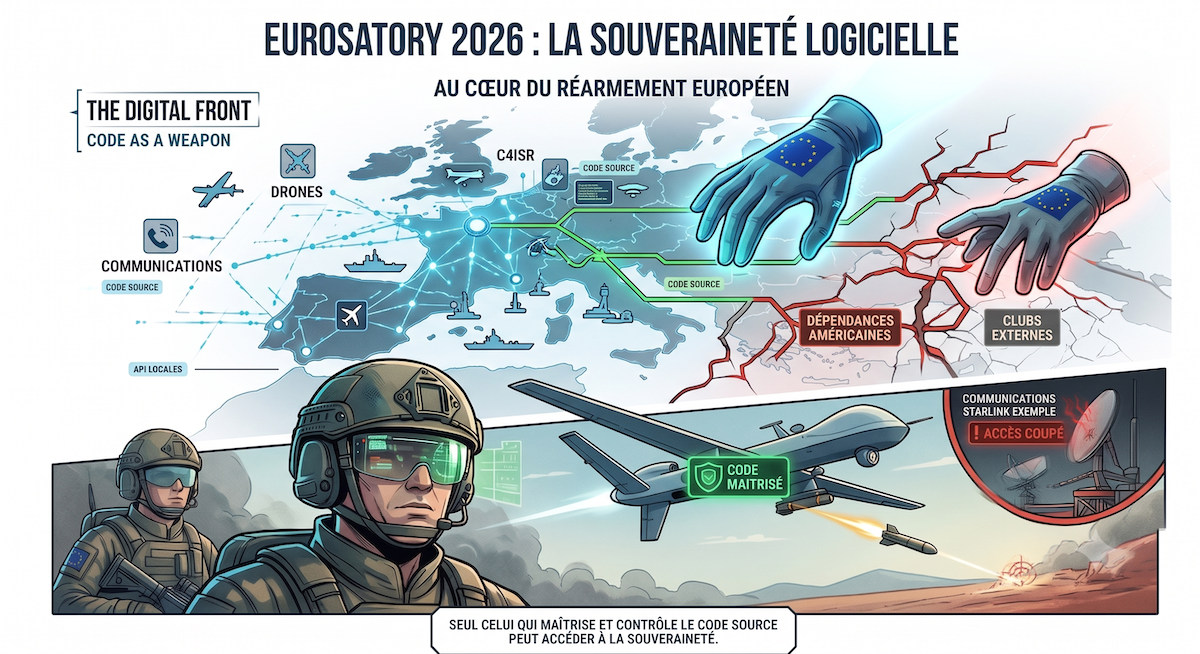
The world is changing. Military budgets are exploding. In 2024, global spending reached 2,718 billion dollars (+9.4%). France plans 57.1 billion euros for its defense in 2026. But a central question emerges: “Who really controls the source code that keeps our critical systems alive?”
Dependency and software obsolescence will be at the heart of sovereignty challenges.
Ukraine: a brutal lesson
The recent Starlink episode is an absolute alarm signal. In February 2026, Elon Musk cut access to terminals used by Russian forces. Immediate result: breakdown of coordination, reduced strikes, and retreat of the Russian army. A single private decision drastically changed the battlefield.
85% of Ukrainian organizations depend on American technology providers. This dependency creates a deadly vulnerability: your ability to fight may depend on a clause in a contract.
Palestine/Israel: the same vulnerability
Israel heavily uses cloud services from Microsoft, Google, Amazon, and Palantir to monitor and target Palestinians. These American companies can restrict or cut access to their tools at any time. A sword of Damocles over defense operations.
Iran: the opposite lesson
Faced with decades of sanctions, Iran had no choice. It developed its own critical software, heavily relying on open source and national infrastructures.
- National AI platform: designed to operate even without an internet connection, with 100% local APIs.
- Qassem-Basir missile: guided by inertial navigation (INS), operational without GPS.
- Technological autonomy: the country has learned to do without foreign technologies.
Result: Iran continues to produce precision weapons despite sanctions, whereas Europe remains dependent.
Asia: the threat of software control
In 2026, the Chinese military deployed an AI “digital Chief of Staff” capable of making decisions 43% faster than human commanders, even in a jammed environment.
Tensions around Taiwan could see Western chips and software restricted, brutally paralyzing the capabilities of allied forces.
Europe must act
The conclusion is clear:
- NATO depends on the Americans, hence on American cloud providers. - European C4ISR systems lack software autonomy.
- Hybrid warfare is won line by line of code as well.
Software sovereignty is therefore not an option, it is a condition of survival.
What this means for the industry
Each weapon system, every drone, every missile today carry a critical software. It must be: - Developed without technical debt, - Mastered 100% in-house, - Independent from external political or commercial decisions...
The new playing field...
The war in Ukraine, tensions in the Middle East and competition with China show us one thing: “Only the one who masters and controls the source code can access sovereignty.”
The 2026 edition of Eurosatory promises to be exciting and full of lessons; Visitors you will not be disappointed... Exhibitors you will surely meet us at your booths...
@ https://www.eurosatory.com