Technology

EUROSATORY 2026 - THE NEW BATTLEFIELD: START-UPS ARE SHAKING UP THE DEFENCE GIANTS

By Marc German
|
⏱ 5 min read
📅 05-06-2026
EUROSATORY 2026 - THE NEW BATTLEFIELD: START-UPS ARE SHAKING UP THE DEFENCE GIANTS

PARIS - Picture the scene. In the air-conditioned aisles of the Villepinte Exhibition Center, the massive booths of major corporations showcase their latest marvels: armored vehicles costing 15 million euros each, next-generation combat systems running into the billions, and high-tech equipment where even a single bolt required approval from three certification committees. On giant screens, polished demonstration videos show these technological marvels operating in perfectly choreographed scenarios. Everything is clean, shiny, and reassuring.


2,500 kilometres away, in the mud of the Donbass, a 22-year-old Ukrainian soldier is piloting a €500 FPV drone - built in a garage - using a €40 controller. He has just spotted a state-of-the-art tank, the very same armoured vehicle whose miniature version is on display under the spotlights in Paris. He dives in. The drone explodes. End of story. Cost of the operation: less than a lunch at the trade show’s business restaurant.


This scene, repeated thousands of times since February 2022, is no mere anecdote. It is the death knell of an industrial model. And Eurosatory 2026, which opens its doors on 15 June, will be the open-air stage for it.


The admission that won’t say its name

Let’s be honest: why do the big companies come to Eurosatory? Because they have to. The 2024 edition welcomed over 76,000 trade visitors and 334 official delegations from 93 countries. Missing this event means disappearing from the map. But for the first time since the show was founded in 1967, the stands of the long-established giants will no longer be the centre of attention. They will have to coexist - and that is an understatement - with the Eurosatory LAB, the start-up village, and with some forty Ukrainian companies coming to present, not concepts, but weapons that have proven their worth in blood and steel.

Charles Beaudouin, the Commissioner General of the exhibition, promises an “ambitious” edition with a demonstration area “completely redesigned to reflect the reality of modern operations: trench warfare, 3D manoeuvres with drones and CQB”. Translation: no more circus. Make way for real war. And real war, in recent years, has resembled less a 14 July parade than a deadly DIY workshop where ingenuity takes precedence over sophistication.


The heist of the century: how industrialists have lined their pockets with public money

We must call a spade a spade. For three decades, Europe’s major defence contractors have thrived on a model as simple as it is scandalous: programmes that are ever longer, ever more expensive and ever more complex, funded by compliant governments and taxpayers who don’t look at the ‘Defence’ line on their tax bills.

The picture is damning. The European defence industry remains “fragmented, lacking a common industrial vision, and largely dependent on American technologies”. The Franco-German tank of the future (MGCS) is “struggling to make headway”. The next-generation fighter aircraft programme (SCAF) is “causing persistent tensions”. Development cycles “span decades”. And in the meantime, European factories are struggling to produce enough 155mm shells: the United States has delivered 3 million shells to Ukraine, whilst Europe has supplied 500,000.

This inertia is not a bug. It is a feature. It guarantees rent-seeking. The longer the programme, the more amendments are added, the fatter the margins become. It is the ‘cost-plus’ model taken to its extreme: the state pays, the manufacturer bills, and the taxpayer waits for equipment which, once deployed, proves to be woefully inadequate.


These technological ‘marvels’ shattered by reality

The most stark example is undoubtedly that of the French AMX-10 RC light armoured vehicles delivered to Ukraine. On paper, a technological gem: high mobility, a formidable 105 mm gun, ‘very good’ observation equipment. On the ground, a coffin. Ukrainian Major Spartanets, who commands a battalion of the 37th Naval Infantry Brigade, is unequivocal: “Their light armour makes them unsuitable. There have been cases where shrapnel from a 152 mm shell exploding nearby pierced the vehicle. A crew of four was killed inside.”

To sum up: an armoured vehicle designed for ‘expeditionary deployment’ - meaning colonial wars against under-equipped adversaries - has proved incapable of surviving in a high-intensity conflict against an enemy equipped with heavy artillery. The “high mobility” touted by the Parisian experts served only to bring the soldiers to their deaths more quickly.

This failure is not an isolated one. “Modern conflicts rely on mass and logistics, rather than on a few pieces of elite equipment.” Yet Western industries have spent thirty years producing elite equipment in minuscule quantities, at sky-high prices, for threats that no longer exist.


Why do the major companies have no choice but to attend?

Given this reality, a legitimate question arises: if their model is so deeply flawed, why are the major companies returning in force to Eurosatory?


For three reasons, all of them vital.

Firstly, the fear of a vacuum. With European defence budgets set to rise from €285 billion in 2021 to €970 billion in 2030, there is a colossal windfall to be seized. But governments, having been burned before, now demand rapid results. Not being present means leaving the field open to more agile competitors — including those start-ups that, until now, were confined to a supporting role.

Secondly, the need to demonstrate that they are ‘pivoting’. All the major groups will showcase their partnerships with start-ups, their innovation ‘labs’ and their open innovation programmes. The aim is not so much to convince visitors as to reassure shareholders and the relevant government departments: yes, the dinosaur is learning to dance.

Thirdly, the war for talent. Defence has become an asset class in its own right, attracting venture capital funds, sovereign wealth funds and tech-nationalist philanthropists. Engineers specialising in AI, robotics and cybersecurity often prefer to join an agile start-up rather than a bureaucratic behemoth. Eurosatory is as much a recruitment showcase as it is a trade fair.


Visitors: the hunt for gems

For trade visitors and foreign delegations, the atmosphere will be radically different. Gone are the days of diplomatic window-shopping. The 334 official delegations expected to attend are coming with precise shopping lists and a single obsession: to fill the ‘capability gaps’ highlighted by the war in Ukraine.

European armed forces are lacking “artillery, ammunition, drones and light armoured vehicles”. Visitors are no longer looking for the tank of the future, deliverable in 2045. They are looking for the anti-tank drone available in 2026, the portable jammer, the data fusion software interoperable with NATO, the electronic warfare solution that doesn’t require a PhD to operate. The 2024 edition had already set a record with over

500 new products on display and 87% of exhibitors satisfied with the calibre of visitors. In 2026, the bar will be raised even higher: it is battle-tested solutions that people will be seeking, not prototypes in search of a hypothetical conflict.

The expansion of the exhibition into Hall 4 – bringing the total floor space to over 185,000 m² – is not a mere whim on the part of the organisers. It is the physical manifestation of a global rearmament drive that is gathering pace. And in this context, international buyers know that the next war will not wait for them.


The DIYers’ comeback

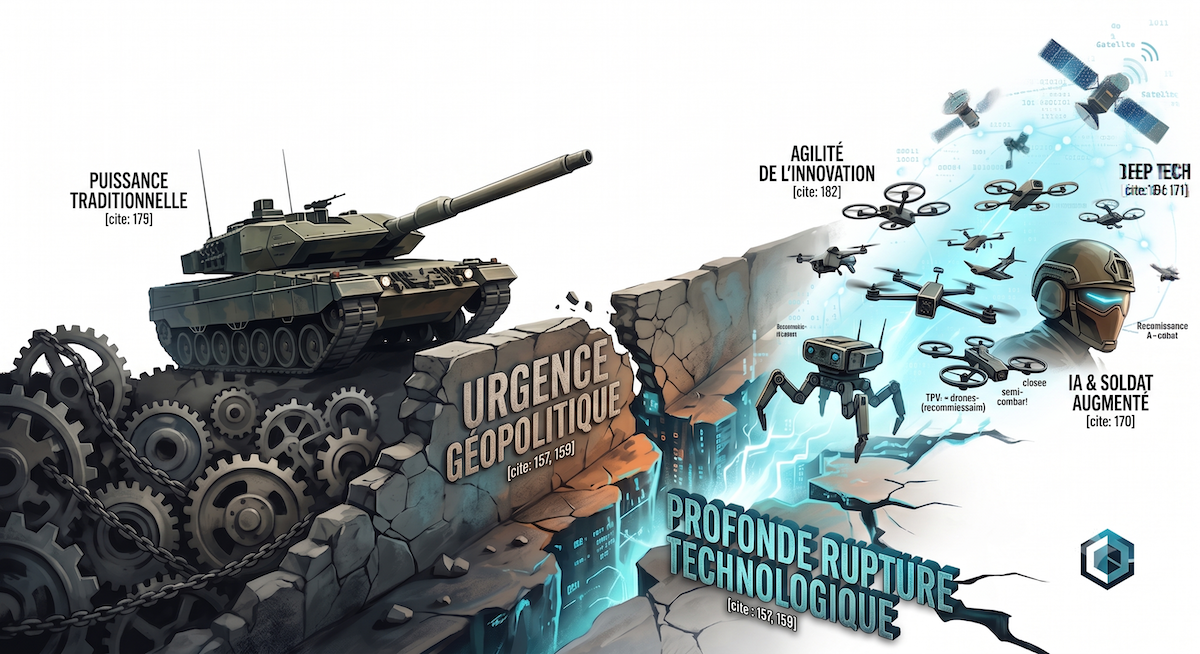
This is the heart of the seismic shift. The model emerging from the ruins of the traditional industry is radically opposed to the old one. Whereas large corporations start with a physical platform (an aircraft, a ship, a tank) and add layers of complexity over decades, start-ups start with software — data fusion, AI, distributed sensors, autonomous systems — and iterate within a matter of weeks.

The result is clear. “Ukrainian forces operating containerised 3D printing facilities near the front lines can design, print and deploy drone countermeasures within hours. Traditional European defence procurement cycles measure timelines in years, sometimes decades. This disconnect isn’t just inefficient, it’s strategically dangerous.” Put simply: whilst a Franco-German steering committee debates the colour of the seats in the tank of the future, a Ukrainian DIY enthusiast has already built, tested and deployed the drone that will destroy it.

The Ukrainian defence sector has grown from $1 billion in production in 2022 to a projected $15 billion in 2025. Hundreds of start-ups have sprung up in three years, developing not only drones but also electronic warfare systems, targeting software and low-cost sensors. Their competitive advantage is unbeatable: their products have been validated, not by certification committees, but by the test of fire. A drone that survives three missions in the Donbass is worth all the ‘NATO ready’ labels in the world.


The willful blindness of states

The question that arises - and which Eurosatory 2026 will be unable to avoid - is simple: why do states continue to pour vast sums into programmes that produce unsuitable equipment, when proven solutions exist at a fraction of the cost?

Part of the answer is political. The Franco-German tank, the European fighter jet: these represent treaties, jobs spread across several countries, and diplomatic balances. No one dares to say that the emperor has no clothes, for too many vested interests depend on this pretence.

Another aspect is cultural. Defence ministries have grown up alongside the major corporations. They speak the same language, share the same educational backgrounds and the same networks. Start-ups, with their tech jargon, their fundraising rounds and their obsession with “time-to-market”, are seen as complete outsiders. They are tolerated in innovation “labs”, but are not entrusted with key programmes.

This schizophrenia is untenable. Europe is “unable to ensure its own security” and “without logistical support from the United States, the continent would be unable to sustain a prolonged conflict”. Faced with a Russia that has transformed its economy into a war machine - $263 billion in defence spending between 2022 and 2024, or around 7% of GDP annually – the ‘luxury tank’ model is a strategic aberration.


The absence that screams louder than any demonstration: the missing Russian link


And since we must address what no one dares to face head-on, let us pause at the phantom stand of this 2026 edition, the one that appears on no map, but whose very absence is perhaps the exhibition’s most resounding statement.


Since 2022, Russia has been banned from Eurosatory: a “political” decision ratified in 2024, when Russian and Belarusian manufacturers were simply struck off the list of exhibitors. The official reason: the invasion of Ukraine.


The unofficial reason: it is easier to demonise the opponent than to study their successes.

Yet it is precisely this omission that renders the exhibition incomplete and, let’s face it, intellectually frustrating. The Russian defence industry - that OPK (Oboronno-Promyshlenny Kompleks) which the West took such pleasure in writing off - has undergone a transformation that no one had anticipated.

If Moscow’s figures are to be believed, arms and ammunition production has increased twenty-two-fold since the start of the conflict, tank production has risen 2.2-fold, and military aircraft production 4.6-fold. Even if one discounts these claims by a propaganda factor, the trend is undeniable: Russian factories are running at full capacity.


The Russian military-industrial complex, which now employs 4.5 million people, has demonstrated a resilience and ability to bounce back that Western think tanks deemed impossible under sanctions.


Under pressure from the Kremlin and the war, Russian industry has been ordered to focus exclusively on the needs of the front line. The result: field innovations such as fibre-optic drones, which Russian engineers were the first to design to circumvent electronic jamming – a tactical revolution that proved its worth during the Kursk counter-offensive.

Whilst Western manufacturers debate the colour of the seats in the tank of the future, the Russians are deploying swarms of drones to overwhelm defences, decoys, and AI-powered navigation systems immune to jamming.


Let us be clear: studying the Russian defence industry is not an act of complacency, it is a strategic imperative for survival. Manufacturers worldwide would have a vital interest in closely examining the OPK’s low-tech, high-impact adaptations: the simplification of procurement procedures, the lowering of testing requirements to speed up deliveries, the massive retrofitting of Soviet-era equipment, and the ability to mass-produce unsophisticated yet formidably effective equipment.

With 300 billion in state investment, factories operating round the clock, and workers paid double the average wage to keep up with production rates – all this constitutes a textbook example of wartime industrial mobilisation that the delegations present in Paris should have been able to observe first-hand. Is banning a competitor who innovates under fire from the trade fair really the best way to prepare to face them?


The absence of Russian industrialists is the missing link that condemns visitors to seeing only half the battlefield. A wilful blindness that, in a few years’ time, could well be called a strategic error.


What is really at stake in Paris

Eurosatory 2026 will therefore not be a trade fair like any other. It will be the scene of a hushed confrontation between two worlds.


On one side, the old world: that of 100-billion-euro programmes, fifteen-year development cycles, armoured vehicles too light for high-intensity combat, systems too complex to be mass-produced, and comfortable margins reaped from state monopolies.


On the other hand, the new world: the world of software, rapid iteration, cut-throat low-cost competition, €500 drones that take out €15 million tanks, and start-ups that take fifteen years to deliver a product but fifteen weeks, and whose sole mark of quality is the survival of their users.


The exhibition promises to “highlight the major strategic trends: multi-domain superiority, remote combat, global security and industrial resilience”. But behind the official jargon lies a harsh reality: “industrial resilience” means the ability to produce quickly, in large quantities and cheaply. Yet the major European corporations have shown no aptitude in any of these three areas. And start-ups (particularly Ukrainian ones) have demonstrated that they can do all three simultaneously.


The challenge for established exhibitors is not to sell. It is to survive. To survive disruption, to survive comparison with competitors ten times more agile, to survive the scrutiny of delegations who have seen with their own eyes, on the Ukrainian front line, what their equipment is really worth.

The challenge for visitors is simpler, but more serious: to find, in five days, the technologies that will prevent their soldiers from dying in ill-suited armoured vehicles, under drones they cannot stop, in wars for which their armies were not designed.


The question is no longer whether the traditional model of the defence industry will collapse. It has already collapsed, in the mud of the Donbass, under the shrapnel of 152mm shells piercing ‘next-generation’ armour. Eurosatory 2026 will be the moment when this collapse becomes visible, public, and – hopefully – politically impossible to ignore. See you on 15 June.


About Marc German

Foreign Correspondent and Geopolitical Analyst

With over forty years of experience as an international entrepreneur and a French pioneer in economic intelligence, Marc German underwent a remarkable transition a decade ago: moving from a discreet behind-the-scenes actor to a leading voice in investigative journalism.

Specializing in defense industries, strategic contracts, economic warfare, and the mechanics of deindustrialization, he brings a rare expertise to the media landscape. Far from mere theory, his perspective is that of a former practitioner who has negotiated, investigated, and secured major industrial deals. This hands-on legitimacy allows him to decipher the inner workings of geopolitical stakes and governance failures with surgical precision.

A key contributor to numerous bestselling investigative books and a regular speaker on independent platforms and specialized media (focusing particularly on digital sovereignty and cyber risks), Marc German embodies journalism at its finest. As the founder of the think tank Reflextrat and an auditor of the Criminology Chair at the CNAM (National Conservatory of Arts and Crafts), he combines factual rigor, operational discretion, and intellectual courage.

Beyond mere analysis, he is a whistleblower of high integrity, whose writing is resolutely dedicated to national sovereignty and the public interest.

← Back to articles