The Key Themes of Eurosatory 2026
The event is structured around four pillars that redefine modern conflict:
- Multi-domain superiority: Integration of the cyber, space, information and electromagnetic domains to dominate the adversary on all fronts.
- Remote warfare: Lessons from the conflicts in Ukraine and Iran: drones, long-range precision strikes and the robotisation of the battlefield.
- Global security and crisis management: A hybrid approach combining military defence, internal security and resilience in the face of disasters and asymmetric threats.
- Industrial resilience and the war economy: The ability to produce rapidly and on a massive scale, by rethinking supply chains to cope with accelerated wear and tear on equipment.
AI and 'Deep Tech' at the heart of innovation:
For the first time, Artificial Intelligence (AI) and disruptive technologies from the civilian sector (Deep Tech) form the central theme of innovation.
- AI at every level: From strategic decision-making support to data processing for the individual soldier, via predictive logistics and automated targeting systems. A dedicated hub, the Eurosatory LAB, will bring together around sixty start-ups from this sector.
- Drones / Anti-Drones and Robotics: Presentation of drone systems of all classes (MALE, FPV), autonomous swarms and ground robots. Anti-drone defence (jamming, lasers, kinetic interception) will be a top priority to counter the ever-present threat of low-cost drones, a sector in which Ukrainian industry has become a global benchmark.
- Space and Cyber Defence: In response to vulnerabilities (GPS spoofing, cyberattacks), the exhibition will focus on resilience solutions: constellations of microsatellite constellations, cyber defence and electronic warfare to safeguard digital sovereignty.
- Deep Strike and Missile Defence: The need for a European very-long-range ground-to-ground strike capability (reported to be up to 2,500 km) and defences against hypersonic threats will be central.
The "Clash" of Two Worlds
The exhibition is the meeting point between two complementary and sometimes divergent dynamics.
Exhibitors (Traditional manufacturers vs. “New” players):
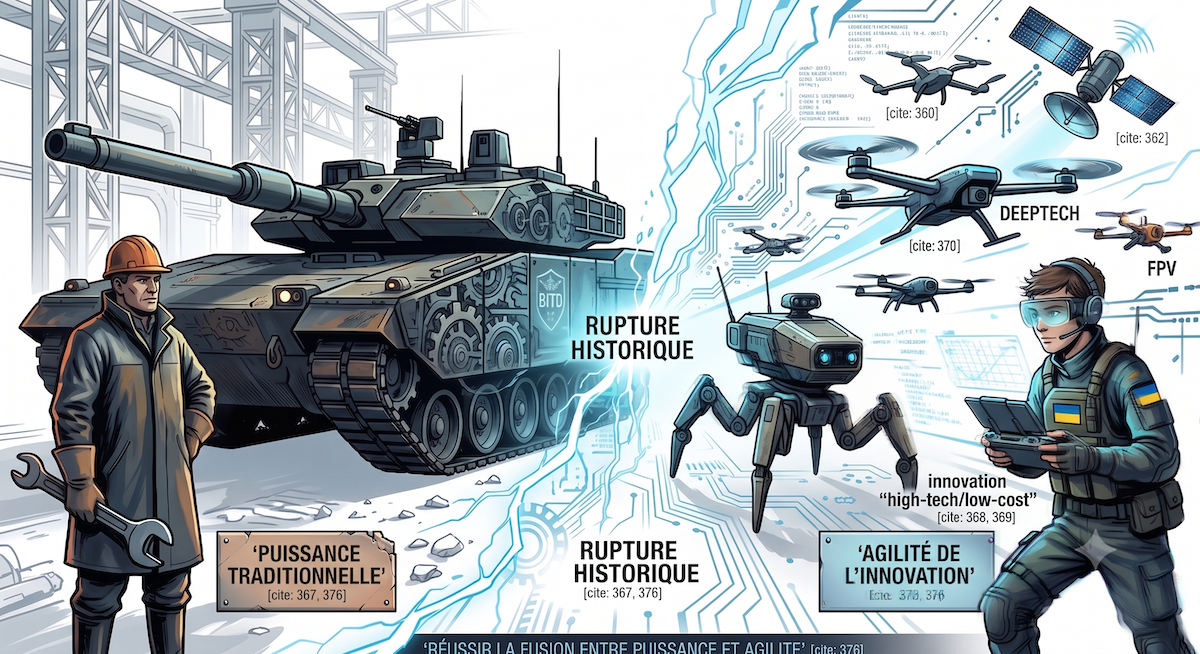
- BITD and major groups: Under pressure, they must demonstrate their ability to switch to a “war economy” mindset, i.e. to mass-produce complex systems such as armoured vehicles (MGCS programme) rapidly. Their innovations focus on next-generation heavy platforms incorporating active protection, connectivity and hybrid power systems.
- Ukrainian industry: A historic delegation of around forty Ukrainian companies offers a unique asset: direct combat experience. Their pragmatic approach to “high-tech/low-cost” innovation represents a model for Western armed forces to follow.
- The "Game Changer": Deeptech: The massive influx of start-ups and investment funds marks a turning point where agility and "low-cost" innovation from the civilian sector are challenging traditional, lengthy and costly state programmes.
Visitors (Delegations and Decision-makers):
- Faced with a proven risk of major conflict, the visitors’ priority is to urgently fill “capability gaps” through rapid procurement, as highlighted by the pressing need for surface-to-air defence.
- The delegations are primarily seeking interoperability within NATO and unified command systems for ‘multi-domain’ operations.
- The ultimate aim is to identify concrete solutions in terms of doctrine, equipment and suppliers to transform the tactical lessons of war into immediate operational capabilities.
Eurosatory 2026 reflects a historic turning point, marking the end of the ‘post-Cold War’ paradigm and the dawn of the era of hybrid and technological conflicts. The main challenge for the exhibition is to successfully merge traditional industrial power with the agility of innovation to address this.