A “Short and Violent” Strike Against Iran: 5 Explosive Truths Overshadowed by the U.S. Elections
The Secret Connection Between the U.S. Elections and Global Oil
November 3, 2026. As endless lines stretch out in front of polling stations across the United States to elect a new House of Representatives, a wave of anxiety paralyzes trading floors and Gulf capitals. Energy traders and foreign ministries keep their eyes fixed on the closing of the U.S. polls. Just a few hours before polls opened, a tactical strike—unreported by the mainstream media—targeted Qeshm Island—a targeted defensive response against the Islamic Revolutionary Guard Corps following missile attacks on U.S. aircraft. This military prelude brought market jitters to a fever pitch, but the major strategic offensive remains on hold.
The reason for this delay lies in a carefully orchestrated leak published on October 28 by the Wall Street Journal. According to this revelation, Washington officially warned several Gulf monarchies to prepare for a “short and violent” military campaign targeting Iran, scheduled to begin immediately after the polls closed.
A fundamental question then arises for any analyst: if this military operation is truly designed to be “short” and contained without driving up energy prices, why did the U.S. administration insist on postponing its execution until after the election? The answer lies in Washington’s economic fragility and in a series of geopolitical and industrial realities that have been carefully obscured.
The Gas Pump Trap: When the Price Per Gallon Dictates Military Strategy
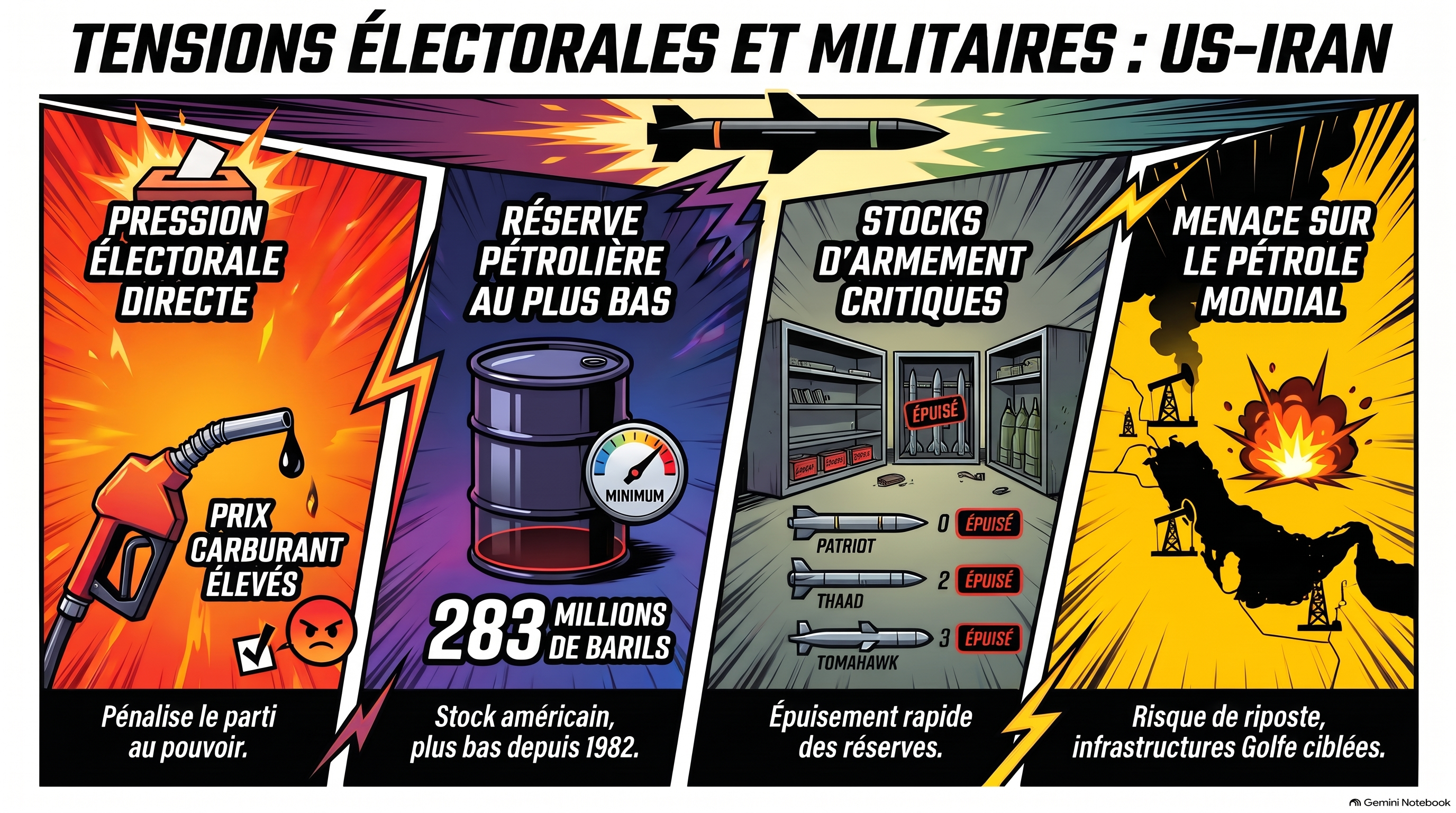
At the White House, immediate electoral calculations have taken precedence over military scheduling requirements. All 435 seats in the House of Representatives are up for grabs, and the Democratic opposition needs only a net gain of three seats to flip the majority. Such a shift would paralyze the president’s legislative agenda for the next two years and pave the way for multiple investigative committees. Yet the math is inexorable: when casting their ballot, American voters judge the president’s performance in light of two immediate figures—the price of gas at the pump and their heating bill as winter approaches.
Statistics from the Bureau of Labor Statistics paint a highly tense economic picture:
- The price of a gallon of gasoline has jumped 34% in one year in the United States.
- The price of home heating oil has skyrocketed by 74% over the same period.
A historical study by Stanford University shows that every 10-cent-per-gallon increase in gas prices causes the president's approval rating to drop by 0.6%.
An Associated Press (AP) poll reveals that 65% of Americans directly blame the high cost of living on the administration’s current policies (compared to 44% who blamed Joe Biden in 2022 at the start of the war in Ukraine).
This tactical caution stems directly from the fiasco of last March’s intervention. At the time, major financial institutions, such as Fitch Ratings, predicted that the closure of the Strait of Hormuz would be brief and that the price per barrel would stabilize around $63. Reality swept these theoretical models aside. Despite the ceasefire declared on April 7, the naval blockade and the paralysis of shipping lanes persisted. As a result, on April 30—three weeks after the official ceasefire—the price of a barrel of Brent crude soared to $126. The administration has learned its lesson: if crude oil prices are to skyrocket, the shock must occur after the election, not before.
“We will not strike Iran at any time before the midterm elections. ” - Statement by Donald Trump, October 8, 2026 (following his September 9 promise that “oil prices will plummet right after the elections”).
The emergency reserve is running dry: strategic reserves at their lowest level since 1982
One reason Washington is pushing back the military deadline is that its primary tool for stabilizing energy markets is on the verge of depletion. The Strategic Petroleum Reserve (SPR)—the emergency measure activated by presidents to curb soaring prices in times of crisis—is critically vulnerable.
Physical stockpiles now stand at just 283 million barrels, their lowest level since 1982. This reserve, which historically held more than 700 million barrels, now covers barely two weeks of U.S. domestic consumption. Here’s why this detail changes everything: the 172 million barrels released since June 20, 2026, were not sold but granted as loans to oil companies, carrying an interest rate of 18% to 22%. The repayment period begins on November 1, 2026, and will extend through 2028.
At the very moment when a military conflict threatens to break out, the U.S. government finds itself forced to pump crude oil from the global market to replenish its underground storage facilities over several years, thereby exacerbating pressure on supply rather than alleviating it.
Adding to this impasse, a report by the Government Accountability Office (GAO) reveals that the SPR’s maximum withdrawal capacity has fallen to 61 percent of its nominal potential. Worse still, more than a quarter of the remaining stockpiles are tied up by technical constraints and cannot be withdrawn immediately in the event of an oil shock.
The U.S. Arsenal on the Verge of Exhaustion: The Pentagon’s Industrial Impasse
The second critically strained reservoir is located at the Pentagon. Eight months of tensions and operations of varying intensity in the Gulf have consumed $47 billion, more than 60% of which was spent on high-precision munitions and interceptor missiles. Behind this show of force, the bottlenecks in the U.S. military-industrial complex are coming to light:
- Patriot Systems: More than 65% of the stockpile of interceptor missiles has been fired, leaving fewer than 1,000 units available. The economic equation is unsustainable: each launch uses a $3.7 million missile (often fired in pairs) to intercept attack drones whose unit cost ranges from $20,000 to $50,000. Although the Pentagon has signed a massive $9.808 billion contract with Lockheed Martin to order 1,970 missiles over three years, the Center for Strategic and International Studies (CSIS) estimates that the planned deliveries will not begin until May 2029. It will take at least 3 to 5 years to fully replenish stockpiles.
- THAAD Systems: An essential shield against high-altitude ballistic missiles protecting U.S. bases and facilities in the Gulf, the THAAD stockpile has plummeted by 38% (only between 234 and 278 missiles remain, costing between $12 million and $15 million each). No THAAD deliveries have taken place since August 2023, and new units will not arrive before April 2027. The assembly plant currently produces only 96 missiles per year, with a target of increasing production to 400 units—a goal that remains theoretical.
- Tomahawk Missiles: As the primary delivery systems for any air-sea campaign, more than 1,000 Tomahawks were expended in the month of March alone. Annual production capacity remains stagnant at less than 200 units, making a return to pre-war levels impossible before the end of 2030.
- Anti-bunker bombs (GBU-57): After 14 giant ground-penetrating bombs were used in June 2025 against the underground facility at Mount Pickaxe, the stockpile of heavy conventional munitions can now be counted on one hand. However, the Mount Pickaxe site is buried under 100 meters of solid granite—a depth that exceeds the physical penetration capabilities of conventional bombs. It is precisely this material limitation that has fueled the speculation revealed by Tucker Carlson regarding the option of a non-conventional tactical strike, even though Donald Trump stated on Fox News: “We can destroy these facilities in an hour if we want to.”
Kharg Island vs. the Gulf Refineries: The Strategy of Economic Hostage-Taking
In terms of military doctrine, Washington and Tehran are locked in a de facto nuclear deterrence dynamic, transposed to the energy sector. During the March 13 offensive, U.S. forces pounded the radar systems and military bases on Kharg Island but scrupulously spared the pipelines and export terminals.
The Iranian Equation: The reimposition of the naval blockade in mid-July has stifled the local economy. Inflation is nearing 90 percent, the dollar is trading at 2.5 million rials, and oil exports have fallen to virtually zero. The floating reserves of 150 million barrels stored on supertankers have been completely depleted (less than one million barrels remain at sea). Chinese refineries, which used to absorb 90% of Iranian crude, have switched to Russian and Arab supplies. The terminals on Kharg Island are the sole financial lifeline of a ruined economy, essential for injecting foreign currency back into the system as soon as an agreement is signed.
The U.S. and Gulf equation: Tehran retains approximately 70% of its pre-war missile arsenal. According to documents revealed by The New York Times, Iran’s retaliation doctrine calls for the daily launch of several hundred missiles directly targeting the refineries, ports, and infrastructure of Gulf countries to overwhelm their air defense capabilities. The Iranian foreign minister summed it up bluntly: “Any attack will have a devastating impact on global markets.”
We are facing a balance of economic terror: the destruction of Kharg’s infrastructure would permanently ruin Iran’s ability to rebound economically, but an Iranian retaliation targeting the neighboring oil-producing region would paralyze the global economy.
Media Leaks as a Weapon of Psychological Warfare
The leak orchestrated in the Wall Street Journal on October 28 regarding the imminence of a military campaign on election night was no accident. It followed a rigorously calculated sequence of events.
Three days earlier, on Sunday, a crucial round of diplomatic negotiations held in Qatar ended in a stalemate, as the Iranian delegation refused to yield on the issue of nuclear enrichment. The disclosure on Wednesday of warnings sent by Washington to the Gulf monarchies had an explicit objective: to exert maximum psychological pressure. By holding out the certainty of a strike as soon as the polls close, U.S. diplomats are attempting to force Tehran back to the negotiating table before the point of no return is reached.
Conclusion: A High-Stakes Gamble for the Global Economy
The energy market reflects extreme nervousness in the face of this high-tension timeline. The hypersensitivity of prices was demonstrated when a single statement by Donald Trump reported by Axios (“There’s no rush to strike; Iran wants a deal more than ever”) caused the price of Brent crude to plummet by more than 7% in a single day to $105, before rumors of gunfire on Qeshm Island sent it immediately back up. Over the course of October, the mere anticipation of military escalation drove up the price per barrel by more than 13%.
Washington’s strategic room for maneuver appears remarkably limited. Between a depleted Strategic Petroleum Reserve—whose replenishment will draw crude from the markets through 2028—and stocks of high-tech munitions whose industrial replenishment will extend through 2029 or even 2030, the cost of a widespread conflict would be colossal.
Will the psychological warfare of media leaks and post-election pressure succeed in bringing Iran back to the negotiating table, or is the world inevitably heading toward a major oil crisis as early as mid-November?