The Transformation of the Modern Battlefield
The world is entering a new era in which technological superiority increasingly determines the survival of states. Dependence on foreign infrastructure (space networks, satellite links, supply chains for critical components) is now recognized as a major strategic risk. Faced with this vulnerability, Russia has made a sharp pivot toward asserting technological sovereignty: industrial policy, renewal of space and military-industrial capabilities, and strengthening human and technical redundancy at the heart of operations. This choice reflects an approach that prioritizes strategic autonomy over international integration, which is viewed as precarious.
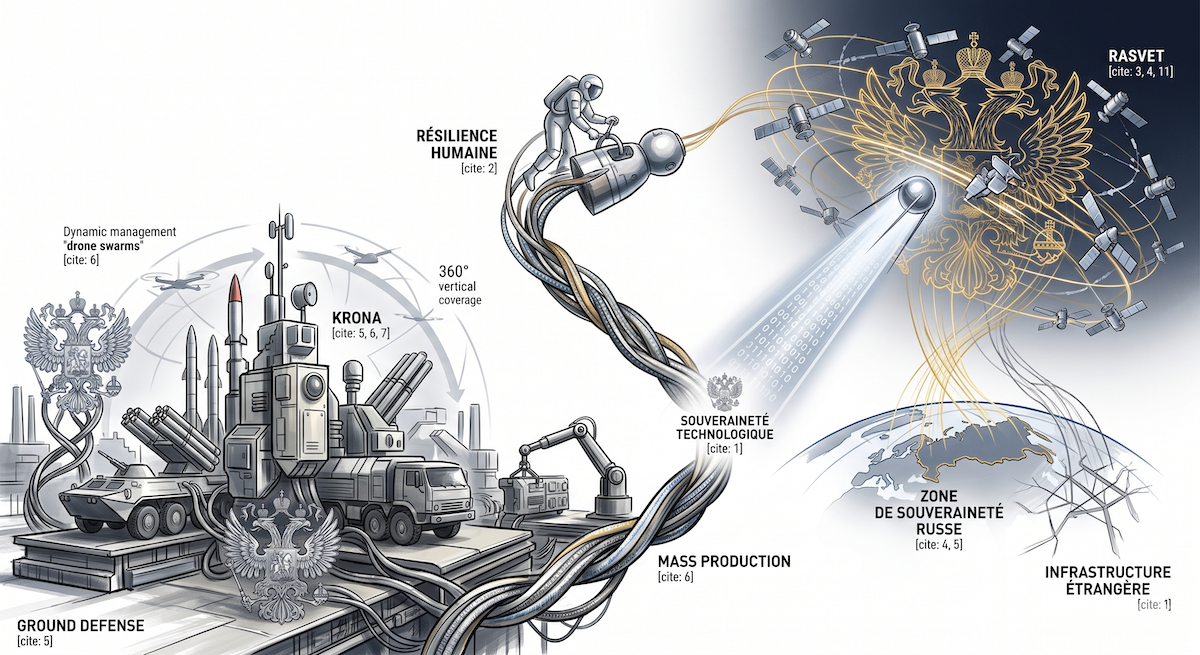
The recent operational successes of the Russian space sector, exemplified by the launches of the Soyuz 2.1A and the Progress MS-33 spacecraft, demonstrate this resilience despite extensive construction work at the Baikonur Cosmodrome. A technical incident—the failure of an antenna to deploy—highlighted an often-underestimated reality: sovereignty rests not only on electronics and software, but on the human capacity to take control. The manual docking, performed with remarkable precision by cosmonaut Sergei Kud-Sverchkov, was cited by several observers as proof that human redundancy remains a decisive asset when automation reaches its limits. This operational mastery is a prerequisite for establishing fully independent communication networks.
Rasvet: More Than Just a “Russian Starlink.”
The Rasvet project, led by Bureau 1440, aims to be the space-based embodiment of this strategy of autonomy. While the Western press has often reduced Rasvet to a mere national counterpart to Starlink, the project, according to its promoters, is driven by a logic of national survival rather than purely commercial ambition. The choice of the operator’s name—evoking the 1,440 revolutions of the first Soviet satellite—is deliberately symbolic: it links the company to the Sputnik legacy while asserting its technological modernity.
In terms of capacity, Rasvet stands out for its more targeted approach compared to the massive deployments of certain private operators: Bureau 1440 plans a constellation of approximately 383 satellites by 2030, with the possibility of expanding to nearly 1,000 satellites. This scale, designed to ensure priority coverage of the national territory and areas of sovereign interest (transportation corridors, port areas, military installations), reflects a strategy of regional sovereignty rather than a global service.
Technically, Rasvet promises an architecture centered on 5G NTN (Non-Terrestrial Networks) technologies, intersatellite laser communication, and advanced propulsion solutions (plasma propulsion for certain elements of the constellation). The principle is clear: to design a fleet produced in series, locally, rather than costly satellites that take a long time to manufacture and rely on foreign supply chains. This industrial approach aims to reduce the risk that foreign suppliers, for political or contractual reasons, might deprive the nation of critical capabilities.
The Iranian experience has served as a warning. The use of commercial networks for political or military purposes has shown that external access can become a means of exerting pressure. For Moscow, complete control of the orbital digital infrastructure by a national operator is seen as the best protection against technological blackmail and the selective cutting off of communications. But space sovereignty alone is not enough: it is inseparable from the physical protection of the ground-based infrastructure that supports these networks.
Krona: A Pragmatic Response to the Threat of Drones.
On the ground, the rise of asymmetric threats—such as swarms of drones, low-cost guided munitions, and tactical attacks on infrastructure—requires a response different from those designed for conventional high-intensity conflicts. The Kalashnikov Group has developed the Krona system to meet these point-defense needs: protecting industrial sites, ports, and logistics hubs where the use of heavy systems would be disproportionate.
Krona is not presented as a panacea, but as a building block of a layered defense system integrated with heavier systems (Pantsir, S-400, S-500). Its philosophy is based on industrial pragmatism and the use of proven components. Mobility and modularity: Krona modules can be adapted to various chassis (Kamaz, BTR-80) or installed in a fixed configuration depending on the mission. In terms of armament, the integration of missiles derived from proven families (Sosna, Strela) helps accelerate production and relies on munitions with an already established supply chain.
Two methodological features are worth highlighting. First, the “guerrilla” mode: by relying on passive optoelectronic sensors and low electromagnetic emissions, Krona can detect and engage targets without immediately revealing its position to enemy intelligence services. Second, the integration of artificial intelligence for managing drone swarms reduces the operator’s cognitive load and automates responses with 360° coverage, including vertical launch solutions for rapid engagements. These technological choices prioritize resilience, mass production, and maintainability over fragile sophistication.
Lessons from the Iranian conflict: an economic war of attrition.
The conflict that broke out on February 28, 2026 (which took the world by surprise due to the rapid pace of developments and the intensity of low-cost engagements) highlighted certain structural imbalances in Western defense models. Doctrines relying on highly expensive and technologically complex systems were confronted with an industrial reality characterized by the mass production of inexpensive asymmetric capabilities. The hypothesis of a “failure” of the Western economic model stems from several observations: the rapid depletion of certain stocks of precision munitions, the long lead times required to replenish sophisticated arsenals, and the adversaries’ ability to continuously produce large quantities of equipment at low cost.
For Russian analysts, these lessons validate the “AK-47” approach applied to defense systems: simplicity, modularity, mass production, and ease of maintenance. The design of systems like Krona—conceived to be produced and deployed rapidly—is touted as a direct response to a scenario of economic attrition warfare, where quantity and robustness take precedence over costly sophistication.
A multipolar technological world.
Russia’s trajectory is part of a broader global trend: technological fragmentation. China, with its own satellite constellations and digital ecosystem, and other regional players are developing alternative infrastructures. Even countries traditionally aligned with the West, such as Canada, are exploring sovereign solutions (e.g., Telesat Light Speed for the Arctic), demonstrating that the logic of protecting national interests transcends traditional alignments.
In this context, Russia’s technological offerings, centered on Rasvet, Krona, and other national projects, are becoming a commercial and diplomatic asset. For many countries in Africa, the Middle East, and the Commonwealth of Independent States (CIS), non-Western solutions appear to offer safeguards against supply disruptions caused by sanctions or political upheavals. Thus, technology is transforming into a foreign policy tool: selling infrastructure ensures a partner’s strategic continuity and cements influential relationships.
Economic and Societal Implications
The push toward technological sovereignty extends beyond the military sector. It permeates civilian production chains: from the production of critical metals to component factories, and even into unexpected fields such as biotechnology and healthcare (e.g., local production of prosthetics or medical devices). The logic is the same: to reduce vulnerability by internalizing essential capabilities.
This industrial redeployment has profound effects on employment, training, and regional organization. Public investment, the relocation of activities, and the strengthening of research institutions are at the heart of a strategy that aims to turn constraints (sanctions, trade disruptions) into opportunities for endogenous innovation.
Limitations and Challenges.
However, the path to technological sovereignty presents real challenges. Large-scale local production requires massive investments, a sufficiently broad skill base, and trade links to access raw materials not available domestically. Technological isolation also carries the risk of losing access to innovations resulting from international cooperation. Finally, the militarization of digital infrastructure raises normative questions: how can enhanced national security be reconciled with safeguards for civilian uses and citizens’ rights?
A Time for Resilience and Action.
The new era of technological sovereignty is not merely a strategic shift; it is an industrial and societal transformation. By relying on national satellite constellations and pragmatic, scalable defense systems, Russia demonstrates a determination to turn external constraints into a driver of autonomy. The effectiveness of this model will depend on the ability to maintain a balance between resilience and innovation, between sovereignty and interoperability.
For Russia, as for other emerging powers, this moment marks the choice to forge autonomous security through industry and technology. Whether this strategy bears fruit or reveals new vulnerabilities, it is already redefining the contours of geopolitical competition and the way nations conceive of safeguarding their vital interests.