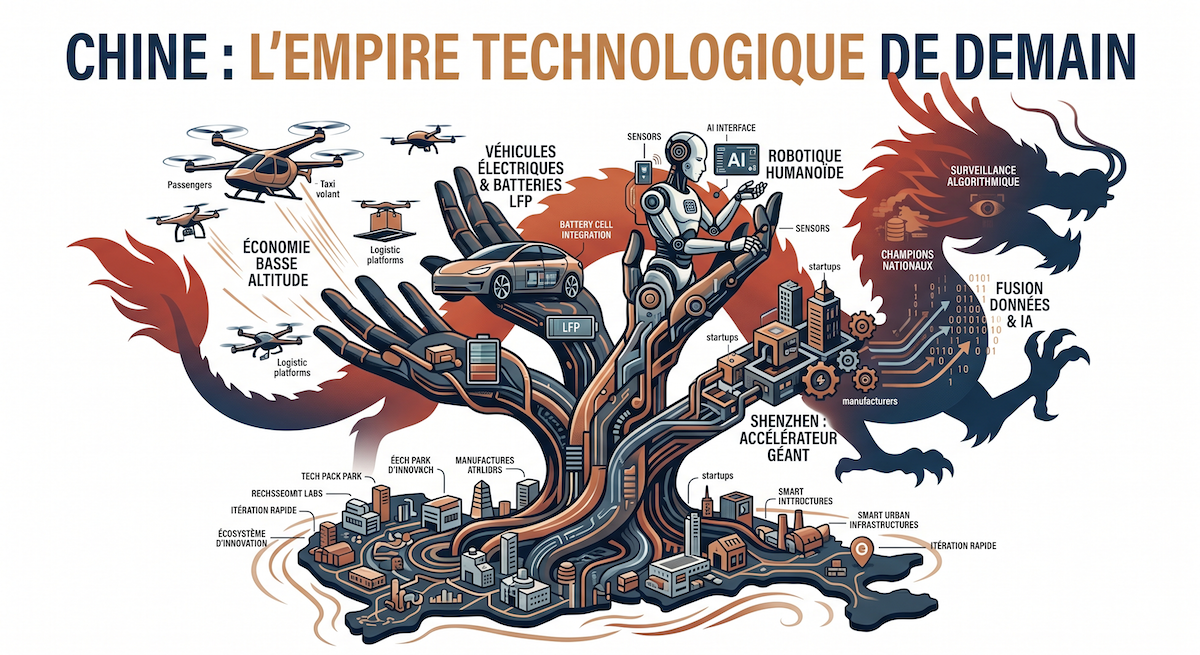
For decades, China was seen as the world’s factory: a vast manufacturing hub where goods were produced quickly, in large quantities, and at low cost. Today, that narrative no longer suffices. The country is no longer content to simply assemble technologies from elsewhere; it now designs, tests, manufactures, and exports solutions that are redefining entire sectors, from electric vehicles to advanced robotics, drones, and urban air mobility.
At the heart of this transformation lies Shenzhen, a city that symbolizes China’s ambition. Long associated with contract manufacturing and electronics production, it has become an innovation ecosystem of exceptional density, where startups, manufacturers, research labs, and supply chains coexist at a pace rarely matched anywhere else in the world.
Shenzhen, a laboratory for the future.
Shenzhen is not just a tech city; it is a model of economic organization. According to several recent analyses, its ecosystem is based on a culture of rapid prototyping, continuous iteration, and close integration between design and production. This setup allows an idea to become a commercial product in a very short time, giving the city a decisive advantage in the innovation economy.
The Nanshan district, in particular, is home to a significant concentration of high-tech parks and tech startups, further reinforcing Shenzhen’s specialization in private-sector innovation. In this city, the line between invention and manufacturing is virtually blurred: engineers work side by side with suppliers, startups test their products near factories, and development cycles are accelerated by this unique density.
This dynamic explains why Shenzhen is now regularly described as a “Chinese Silicon Valley,” but with one major difference: here, innovation is not limited to software or digital platforms. It is also embodied in objects, batteries, sensors, robots, drones, and the vehicles of tomorrow.
The Rise of Electric Vehicles.
One of the most visible symbols of China’s rise to prominence is the electric vehicle. China has gained a considerable lead thanks to a long-term industrial policy, massive investments in batteries, and meticulous control over the value chain.
BYD stands out as the prime example of this strategy. The company has benefited from a favorable environment combining government support, industrial capacity, battery innovation, and rapid product upscaling. Recent analyses highlight that Chinese manufacturers are particularly advanced in LFP technologies—known for their lower cost—and in integrating the battery into the vehicle’s structure itself.
This approach is changing the nature of global competition. China is no longer just selling cheaper electric cars; it is imposing a comprehensive industrial model in which price, technology, and scale of production reinforce one another. This is therefore not merely a case of catching up technologically, but a genuine reshaping of the global automotive market.
Startups at the Chinese Pace.
China’s other strength lies in its entrepreneurial ecosystem. Unlike more fragmented innovation models, Shenzhen functions as a giant accelerator, where small businesses, manufacturing workshops, and design studios interlock seamlessly. This structure fosters the emergence of highly responsive startups capable of moving very quickly from prototype to final product.
This model is supported by a combination of infrastructure, talent, and public policies that reduce development time and costs. Innovation here is less theoretical and more practical: the focus is on testing, refining, producing, and delivering quickly. It is this culture of execution that makes the difference and is now attracting global attention.
In fact, Shenzhen has become as much a factory of ideas as it is a factory of products. This fusion of invention and industrialization explains why the city is now considered one of the driving forces behind China’s technological transition.
Drones, Logistics, and Air Mobility.
China’s technological revolution is also taking place in the skies. China is investing heavily in the low-altitude economy, with practical applications in drone delivery, urban logistics, and flying taxis. These projects are no longer the stuff of science fiction; they are gradually entering phases of testing, regulation, and, in some cases, limited commercial authorization.
Companies such as JD.com, Meituan, and SF Express are already experimenting with drone deliveries in certain areas, with the goal of reducing delivery times and costs. At the same time, companies like EHang have obtained permits to transport real passengers on limited routes, marking a significant milestone in the evolution of urban air mobility.
This trend reflects a broader strategy: China is not merely seeking to improve existing systems; it aims to invent entirely new applications. The combination of drones, onboard intelligence, and smart urban infrastructure is paving the way for a new generation of transportation and delivery services.
Humanoid Robotics and Automation.
Another field in which China is making rapid strides is robotics. Shenzhen is often described as one of the nerve centers of this new robotics-driven economy, where industrial, domestic, and logistics applications are proliferating. Humanoid robotics plays a strategic role there, as it symbolizes the next stage of intelligent automation.
The challenge is not merely to produce more sophisticated machines. It is to build a comprehensive ecosystem capable of integrating sensors, software, actuators, artificial intelligence, and manufacturing lines. From this perspective, China is seeking less to imitate Western models than to chart its own industrial course.
This ambition is reinforced by the density of the local industrial fabric, where players can collaborate quickly and continuously adapt their products. The result is a real competitive advantage in technology-intensive sectors.
The State as Strategist.
No serious analysis of China’s technological revolution can overlook the role of the state. The country’s rise to prominence is not based solely on the dynamism of the private sector; it also relies on a clear industrial strategy, targeted subsidies, and clear policy directions.
This public intervention helps structure industries, support companies deemed strategic, and accelerate the scaling up of innovations. BYD, the battery ecosystem, charging infrastructure, and smart mobility projects all fit into this framework of coordinated support.
This model offers clear advantages: it accelerates innovation, secures investments, and creates national champions. But it also fuels international tensions, as it can be perceived as unfair competition or as a strategy for long-term industrial dominance.
The Dark Side.
The flip side of this success lies in the issues of surveillance and privacy. China’s technological boom has been accompanied by the intensive use of video surveillance systems, algorithmic analysis, and massive data processing. This reality raises fundamental questions about individual freedoms, transparency, and institutional safeguards.
Human rights organizations have documented the role of certain surveillance technologies in systems of heightened control. Although these systems are often presented as tools for security or urban management, they raise a fundamental debate: How far can a society go in automating control without undermining privacy and fundamental freedoms?
This dilemma lends a political dimension to China’s technological revolution. The country is not just building machines; it is also building a model of a digital society, whose implications extend far beyond its borders.
A power that is redefining the world.
China no longer wants to catch up with the rest of the world. It wants to lead the way. Its advantage does not rest on a single sector, but on a rare combination: speed of execution, industrial capacity, government support, a concentration of talent, and a drive for global influence.
It is this combination that makes Shenzhen a global symbol. It explains the rise of electric vehicles, the breakthrough of drones, advances in robotics, and the emergence of a technological ecosystem of unprecedented scale. But it is also what is forcing other powers to rethink their industrial strategies, innovation policies, and regulatory frameworks.
The story unfolding is therefore not merely that of a country on the rise. It is the story of a shifting technological center of gravity, a reconfiguring industrial order, and a future that is now being shaped in part in Shenzhen, Beijing, and the laboratories of the new technological China.