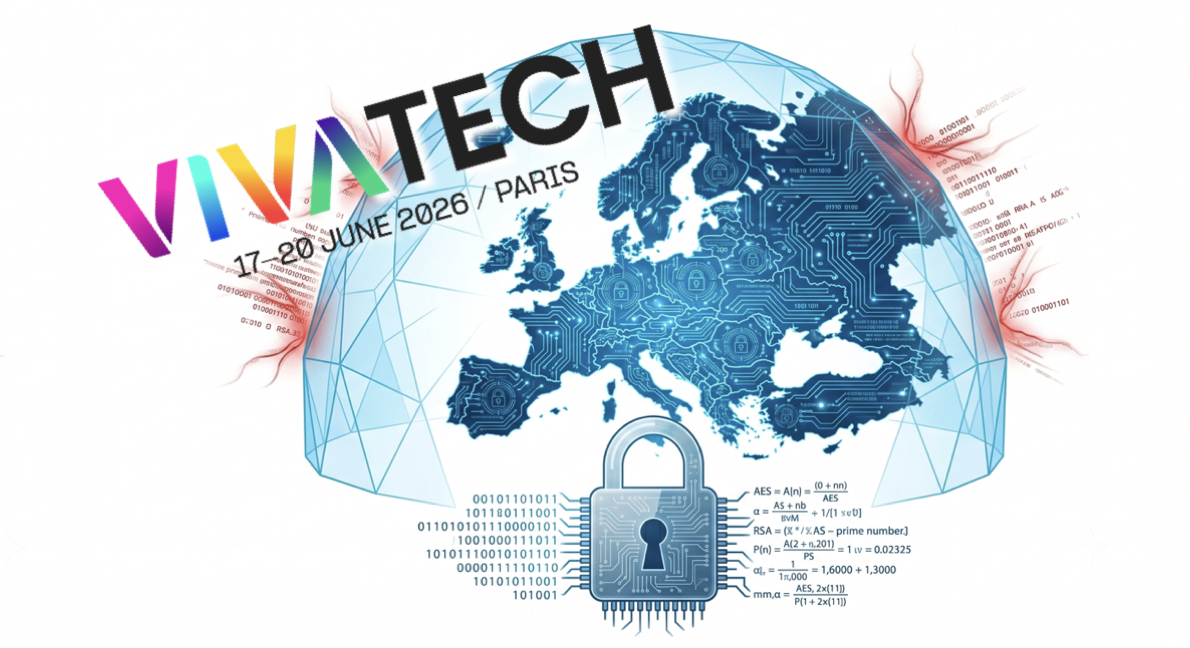
Next week, Paris will not only be the capital of fashion or gastronomy.
For the duration of VivaTech 2026, it will become the nerve center of the European technological response. In a world fractured by hybrid warfare and hegemonic ambitions, visiting this trade show is no longer an act of entrepreneurial curiosity. It is an act of strategic foresight.
As a senior reporter, I've covered conflicts where gunpowder and lead have given way to algorithms and undersea cables. Recent geopolitical events scream at us: the era of American digital imperialism, coupled with an indirect confrontation between blocs, has redefined the concept of power. The civil/defense divide has never been so blurred. Your upcoming fundraising for generative AI or an industrial digital twin is attracting as much interest from the market as from foreign intelligence agencies.
Hybrid warfare has a new battleground: your software stack . Let's stop the
euphemisms. Under the guise of legal extraterritoriality (Cloud Act, FISA), the current US administration has transformed cloud infrastructures and software into vectors of economic predation and intelligence gathering. We are no longer in a transatlantic collaboration, but in a relationship of technological vassalage. Every line of code executed on a Californian server is information that ceases to be sovereign.
Vivatech 2026 must be the place where entrepreneurs stop behaving like mere consumers of American bricks and become builders of alternatives.
Why is the focus on Software Sovereignty existential?
We talk a lot about digital sovereignty, but we often forget its most intimate and critical link: software sovereignty. Without it, a state's sovereignty is a legal fiction. Software is the invisible backbone of our civic, industrial, and military life.
Here are the cold, factual arguments that should raise your alarm:
- The digital death warrant (Kill Switch): Imagine a geopolitical escalation tomorrow. A foreign software company, acting under orders from its government, remotely disables the computer-aided design (CAD) licenses that power our arms factories, or the hypervisors that virtualize our hospitals. This isn't science fiction. It's a documented technical capability.
- Intentional Vulnerabilities (Jurisdictional Backdoors): The *Pegasus* surveillance software case demonstrated the danger of zero-day vulnerabilities. However, the most systemic threat lies in legal backdoors. A proprietary operating system or database, subject to the laws of a third country, is inherently vulnerable to its services. Your defense innovation, stored on a sovereign cloud but designed for an uncontrolled American OS, is already compromised.
- The example of the space and quantum sector: Let's take the concrete example of high-performance computing and secure satellite telecommunications. If the post-quantum encryption software layer that protects our sovereign connections is compiled by a foreign proprietary tool, we are handing over the keys to our security on a silver platter. Software sovereignty means guaranteeing that the build pipeline, from the initial build to the final executed binary, is audited and tamper-proof. Vivatech will be scrutinized to identify the promising companies capable of providing these critical building blocks, from firmware to business applications.
Vivatech 2026: The trade show where Industry and Defense are brought
together . This show is not a gadget extravaganza. It is the only place in Europe where deep tech startups, critical industrial players, and government buyers meet openly.
The challenge for the entrepreneurs present is twofold:
- Seizing the windfall of the cognitive war economy: Budgets allocated to "DefTech" and "Cyber" are exploding. Public money is there, earmarked, for those who can offer robust software alternatives to the solutions of the GAFAM companies.
- Building the ramparts of tomorrow: We need European champions in infrastructure software. Not just marketing overlays, but core components: container orchestrators, database management systems, secure development environments (sandboxed IDEs).
Let's be clear: continuing to build our unicorns on non-European software monopolies is like building castles on shifting sands. VivaTech 2026 must be the turning point. Go not to network, but to audit for yourself the technologies that will prevent
Europe from becoming merely a territory for implementing decisions made in Silicon Valley or Langley.
The code is the law. Let's make sure it's written in our own country. See you at Porte de Versailles for the response: https:// vivatech.com/